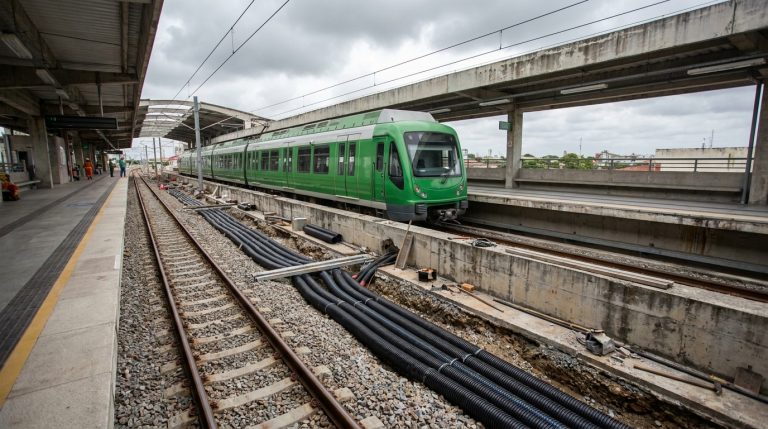



Underground cabling in condominiums is ideal for those seeking greater security and cost savings.
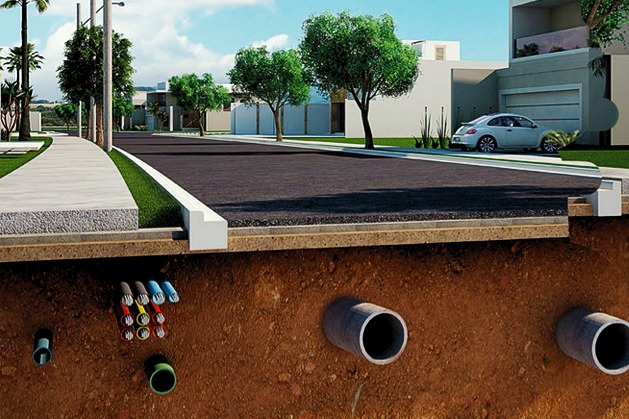
The use of underground cabling in condominiums is growing as discussion on the subject also increases among professionals in the civil construction sector.
In addition to the direct impact on local aesthetics, whether in condominiums or even in neighborhoods and urban centers, underground cabling offers several advantages: greater safety, improved performance, and cost savings. Stay tuned!
Underground cabling in condominiums: how does it work?
Underground cabling in condominiums is a wiring model that replaces overhead wiring, the type with wires connecting utility poles to residential lighting. In addition to visual pollution and high maintenance costs, this type of wiring is exposed to the risk of vandalism, as well as storms and lightning.
In contrast, the underground cabling system in condominiums consists of conduits buried separately in the ground at a minimum depth of about 50 cm, depending on the location. It can be used for electricity, telephone, internet, and TV cables.
In high-end gated communities, there is also the option to implement FTTH (Fiber to the Home), which involves using fiber optics to provide telephone, internet, and TV services. This technology is becoming increasingly common, installed alongside underground power lines.
To protect the wires in underground cabling in condominiums, the installation uses corrugated HDPE (High-Density Polyethylene) pipes, which ensure adequate protection.
The installation of underground cabling in condominiums, in practice
Installation begins with a concrete base that serves as a support for the conduits. Then, they are covered with sand, a technique to compensate for ground movement, with the goal of minimizing the impact of vibrations from vehicles. Finally, the conduits and sand are covered with pavement or soil.
The amount of piping for underground cabling in condominiums is what will determine the width of the conduits. However, the standard choice is 1 meter wide.
In addition to electrical wiring, boxes of varying sizes and passageways, known as transformer chambers, are also installed. They house utility company equipment, such as circuit breakers and transformers, and are often placed in areas easily accessible to residents.
What are the advantages of underground cabling in condominiums?
Greater protection: precisely because it is located underground, underground cabling in condominiums reduces the risks of electrical discharges, power outages, falling trees, and other accidents. The risk of wire breakage in such cases is virtually nonexistent, since in addition to being buried, the cables are protected by sturdy conduits, ensuring less energy waste and a longer service life.
Cost savings and improved performance: underground cabling allows for the transmission of more energy than the overhead model because it can have larger diameters. Thus, the network remains stable, increasing efficiency and reducing energy waste.
Aesthetics: finally, underground wiring allows for the convenience of hiding the wires, leaving the facades visually cleaner and more attractive, which also adds value to the property!
Overhead network vs. underground network: comparison
| Criterion | Overhead network | Underground network |
|---|---|---|
| Initial cost | Lower | Higher (excavation and specialized cables) |
| Maintenance cost | High (pruning, weather damage, repairs) | Low |
| Service life | Short — frequent replacements | Long — 25 to 40 years |
| Safety | Exposed to lightning, wind, vandalism | Protected and buried |
| Aesthetics | Visual pollution | Clean facades, adds value to the property |
The initial investment is higher, but the long-term cost-benefit favors the underground network, thanks to its durability and reduced maintenance.
Underground cabling in condominiums is done with Techduto products!
For installing underground cabling in condominiums, Techduto offers a line of corrugated pipes specifically designed for this type of project.
The Techduto line, which in its NBR version complies with ABNT NBR 15715, is a corrugated HDPE pipe, highly resistant to crushing and impacts resulting from the installation process, and extremely flexible, allowing it to form curves without the need for fittings.
In addition, HDPE is completely non-toxic and environmentally friendly.
If you need a more resistant line with a smooth interior, check out our line of semi-flexible double-wall corrugated pipes Techduto DW. It exceeds the standard by 30% and allows for less coverage during installation.
Contact us to learn more about our solutions!