

Choosing between HDPE corrugated pipe and concrete pipe in drainage projects is not just a technical decision. It is a decision that affects cost, schedule, maintenance, structural risk, and professional reputation.
If you are an engineer, designer, public works manager, or responsible for urban infrastructure, you have faced this dilemma. The budget is tight. The schedule is tight. Inspectors demand performance. And any error in the specification can lead to rework and financial loss.
In this technical and economic comparison, you’ll understand why HDPE is replacing concrete in various drainage applications. Choosing the right pipe must meet four main criteria:
- Structural strength;
- Durability;
- Ease of installation;
- Life-cycle cost.
A common mistake is to analyze only the initial cost per linear meter. When this happens, concrete may seem competitive. But a proper analysis must consider transportation, labor, maintenance, and the risk of failure.
HDPE vs. concrete: quick comparison
| Criterion | HDPE corrugated pipe | Concrete pipe |
|---|---|---|
| Structural behavior | Flexible (works with the soil) | Rigid (prone to cracking) |
| Weight / logistics | Lightweight — easy to transport and install | Heavy — requires hoisting and more trucks |
| Chemical resistance | High (does not corrode) | Vulnerable to sulfates and chemical attack |
| Watertightness / hydraulics | Smooth interior, watertight joints | Irregularities and less watertight joints |
| Installation speed | Fast, less equipment | Slower, heavy equipment |
| Life cycle cost | Lower (durability + low maintenance) | Higher risk of corrective maintenance |
Structural strength: flexible vs. rigid
Concrete is a rigid material. It resists compression well, but is vulnerable to cracking when differential settlement or soil movement occurs.
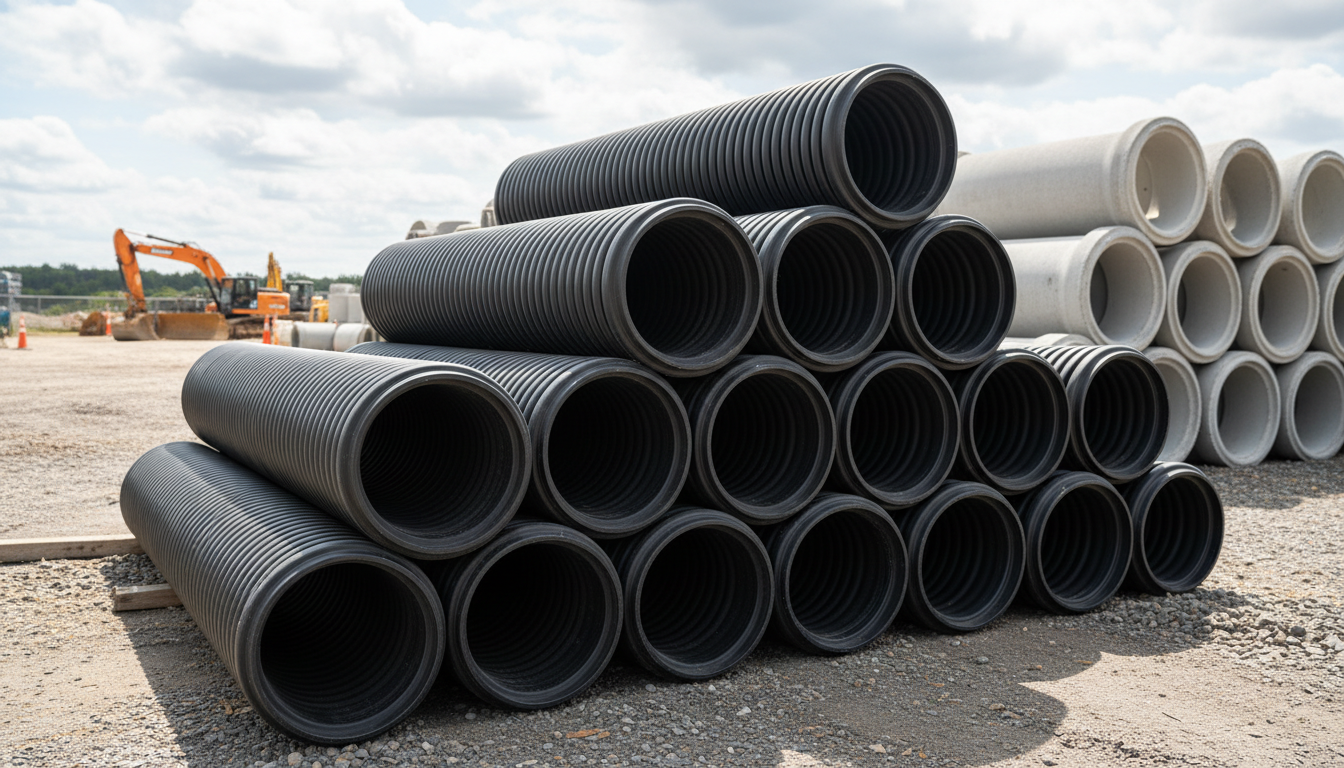
In contrast, HDPE corrugated pipe exhibits flexible structural behavior. It works in conjunction with the surrounding compacted soil, allowing it to absorb deformations without breaking. In urban areas with heavy traffic, constant vibration, and temperature fluctuations, this flexibility reduces the risk of cracks and collapses. Additionally, HDPE has high chemical resistance, which is important in drainage systems that handle wastewater or water with contaminants.
Weight and logistics: direct impact on construction costs
One of the factors that most affects the schedule is logistics. Concrete pipes are heavy and require:
- Lifting equipment;
- Trucks with greater capacity;
- Longer unloading times;
- A higher risk of accidents.
Since HDPE is lightweight, it drastically reduces transportation costs and makes handling on-site easier. In hard-to-reach construction sites—such as rural areas, expanding subdivisions, or extensive linear projects—this difference translates into real savings. In addition, installation tends to be faster, reducing labor hours and freeing up work fronts more quickly.
Durability and Maintenance
When discussing durability, it is essential to consider the application environment. Concrete can be subject to:
- Chemical attack;
- Sulfate corrosion;
- Infiltration through microcracks;
- Joint wear.
HDPE is corrosion-resistant and does not suffer chemical attack in the same way, which increases the drainage system’s service life. In underground networks, where access for maintenance is complex and expensive, this difference is strategic. For those responsible for public or private contracts, reducing the likelihood of corrective maintenance means reducing financial risk and customer dissatisfaction.
Watertightness and hydraulic efficiency
Hydraulic efficiency depends on the interior of the pipe and the connections. Concrete pipes may have internal irregularities and less watertight joints; over time, leaks and loss of base material can occur.
Corrugated HDPE pipes have a smooth inner surface, which improves flow and reduces head loss. For projects requiring even greater strength and watertightness, the double-wall Techduto DW combines an external corrugated shell with a smooth interior. This is critical in urban drainage projects, where flow control is essential to prevent stormwater channels from becoming overloaded.
Installation time: impact on the schedule
In public and private construction projects, time is a critical factor. Concrete requires more time for positioning, alignment, and adjustment—each piece requires specific care due to its weight. HDPE allows for:
- Faster installation;
- Less use of heavy equipment;
- Reduction in direct labor;
- Lower risk of breakage during transport.
In large-scale projects, this difference can shave weeks off the total schedule. For those working with strict deadlines and contractual penalties, this advantage is significant.
Economic analysis: beyond the price per meter
When comparing only the unit price of the pipe, the analysis is incomplete. It is necessary to consider:
- Transportation;
- Installation equipment;
- Execution time;
- Future maintenance;
- Probability of failure.
HDPE may have a similar or even higher initial cost in some scenarios. However, the total life-cycle cost tends to be lower due to its durability and reduced need for intervention. This strategic approach avoids decisions based solely on the initial spreadsheet.
Applications where HDPE has a greater advantage
HDPE typically performs better in:
- Urban drainage networks;
- Parking lots and industrial yards;
- Railway projects;
- Expanding subdivisions;
- Areas with unstable soil.
In soils prone to settlement or moisture fluctuations, the material’s flexibility is a key technical advantage. For underground soil drainage, there is also the Techdreno (perforated) line, and for high flow rates, the Techdreno DW.
When concrete can still be considered
In very specific situations, such as large diameters in areas with extremely stable soil, concrete can still be used. However, even in these cases, it is important to evaluate logistics, site access, and operational costs. The decision must be technical, not cultural: the fact that it has always been done with concrete does not mean it is the best choice today.
Sustainability and environmental impact
HDPE also contributes to projects aligned with sustainable development. Its light weight reduces carbon emissions during transportation, and its durability minimizes the need for frequent replacement. Additionally, hydraulic efficiency improves the performance of drainage networks, reducing the risk of flooding and environmental impacts. In a scenario of rapid urban growth, solutions that combine technical performance with lower environmental impact gain strategic relevance.
Questions to Ask Before Making a Decision
Before specifying concrete or HDPE, evaluate:
- Does the soil pose a risk of settlement?
- Is access to the job site limited?
- Is the schedule tight?
- Does the project require high watertightness?
- Have future maintenance costs been considered?
Answering these questions helps avoid decisions based solely on tradition or initial price.
HDPE is not a trend. It is a technical advancement.
Replacing concrete with HDPE in drainage systems isn’t a fad—it’s the result of technological evolution and the pursuit of efficiency. Modern projects require materials that work in harmony with the soil, withstand variations, and reduce operating costs. For you, who need to deliver performance, meet deadlines, and maintain margins, HDPE offers clear technical and economic advantages.
Talk to the HDPE experts
Techduto specializes in solutions using HDPE corrugated pipes for urban drainage, infrastructure, and applications with high structural demands. Our technical team assists with analyzing your project, determining the appropriate sizing, and selecting the right material based on load, soil conditions, and flow rate. Discover the full range of Techduto products and ensure performance, durability, and safety in your drainage system.