

Choosing the right pipe for railway platform drainage is not just about price per meter. The pipe must withstand the TB-360 type train, last for decades in tropical acid soil, and, according to DNIT's ISF-210 standard, be accompanied by an adequate filtering envelope. The correct design decision prevents track repairs — the wrong one leads to ballast degradation years later.
Which pipe is suitable for railway drainage?
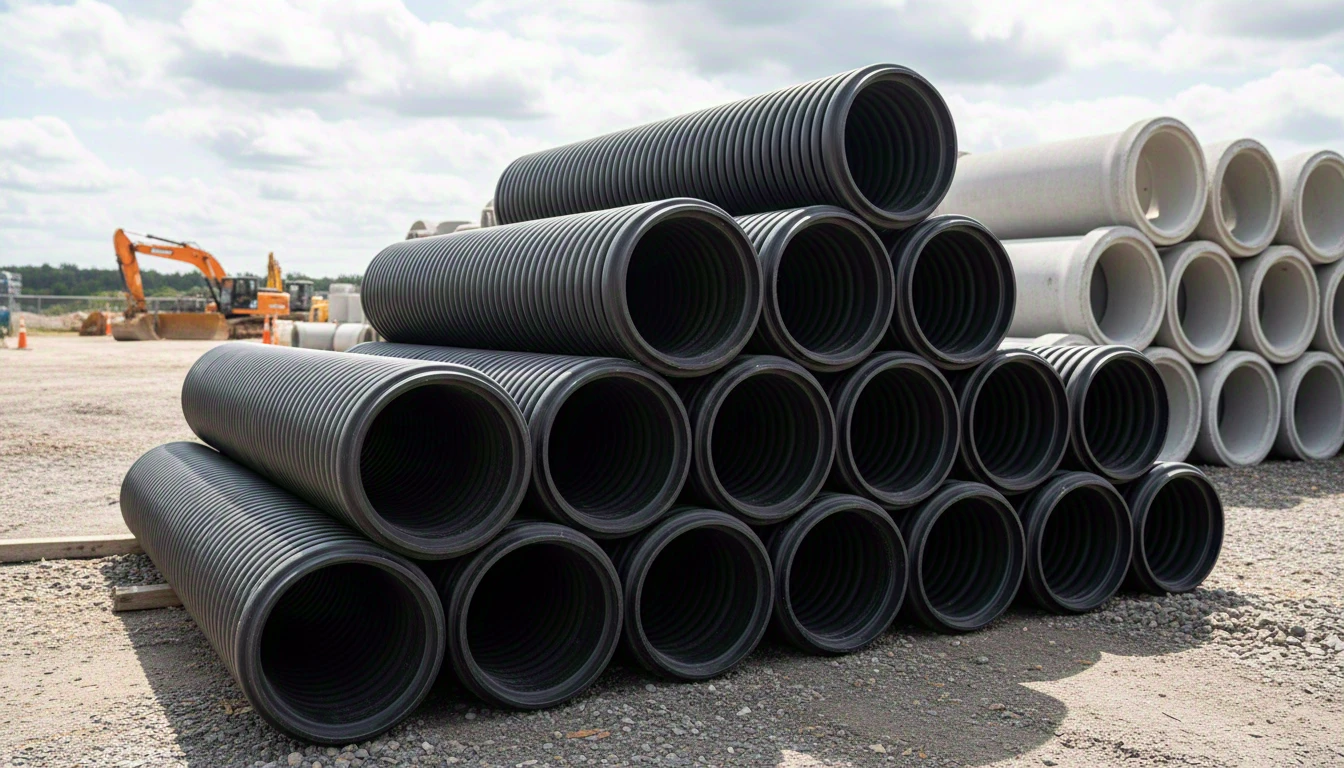
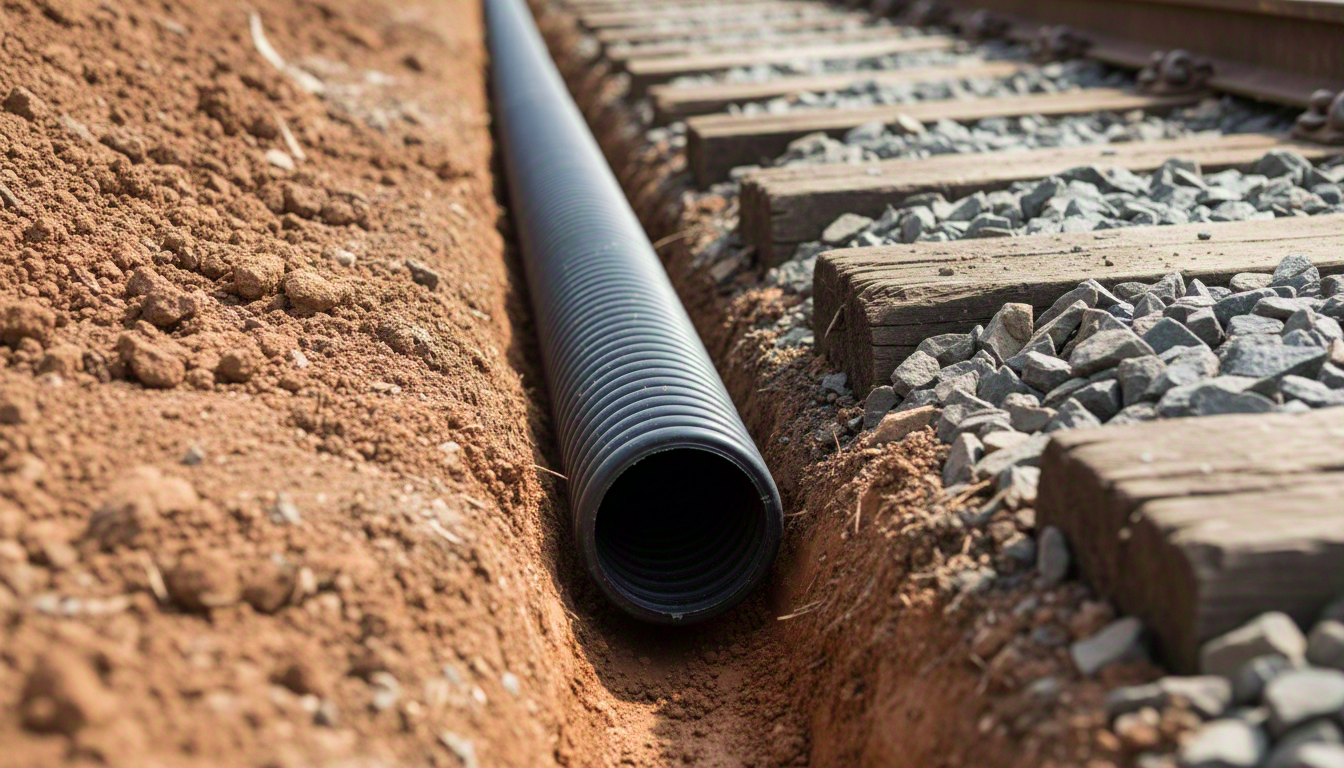
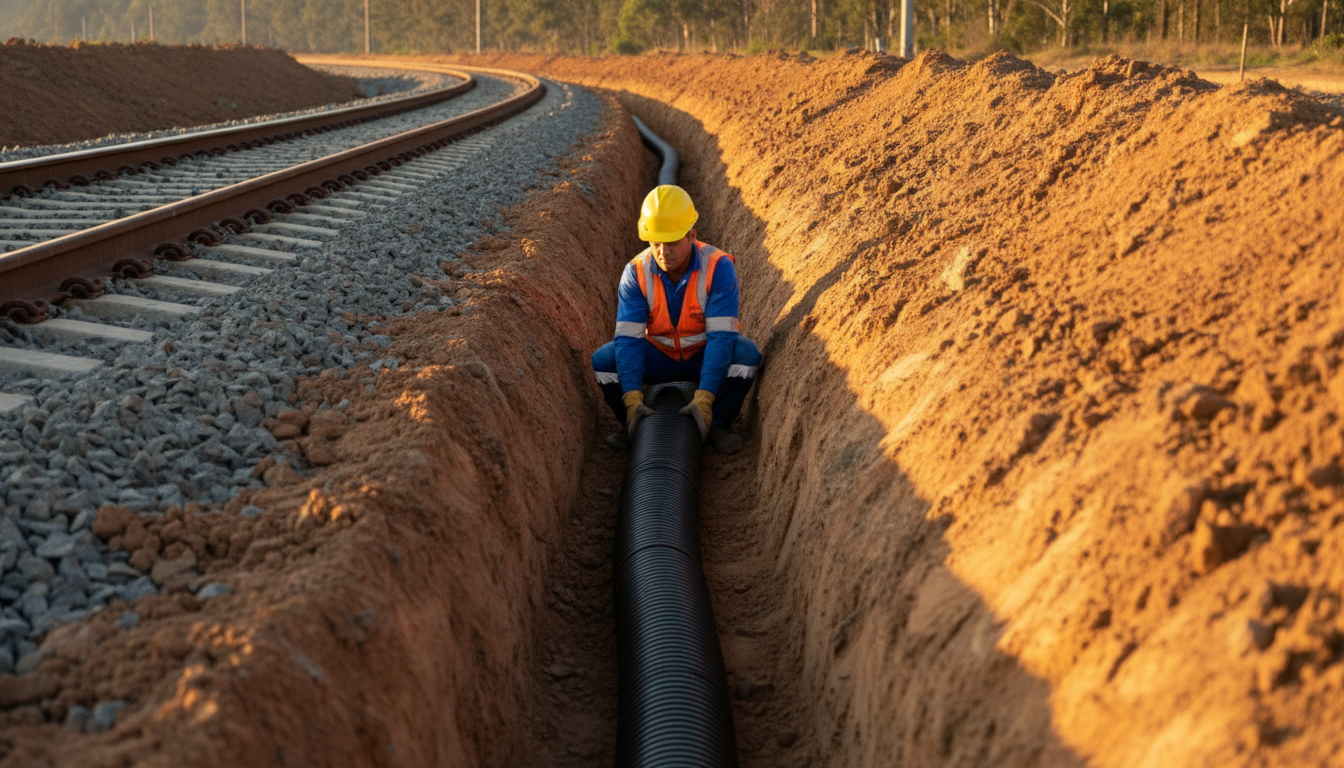
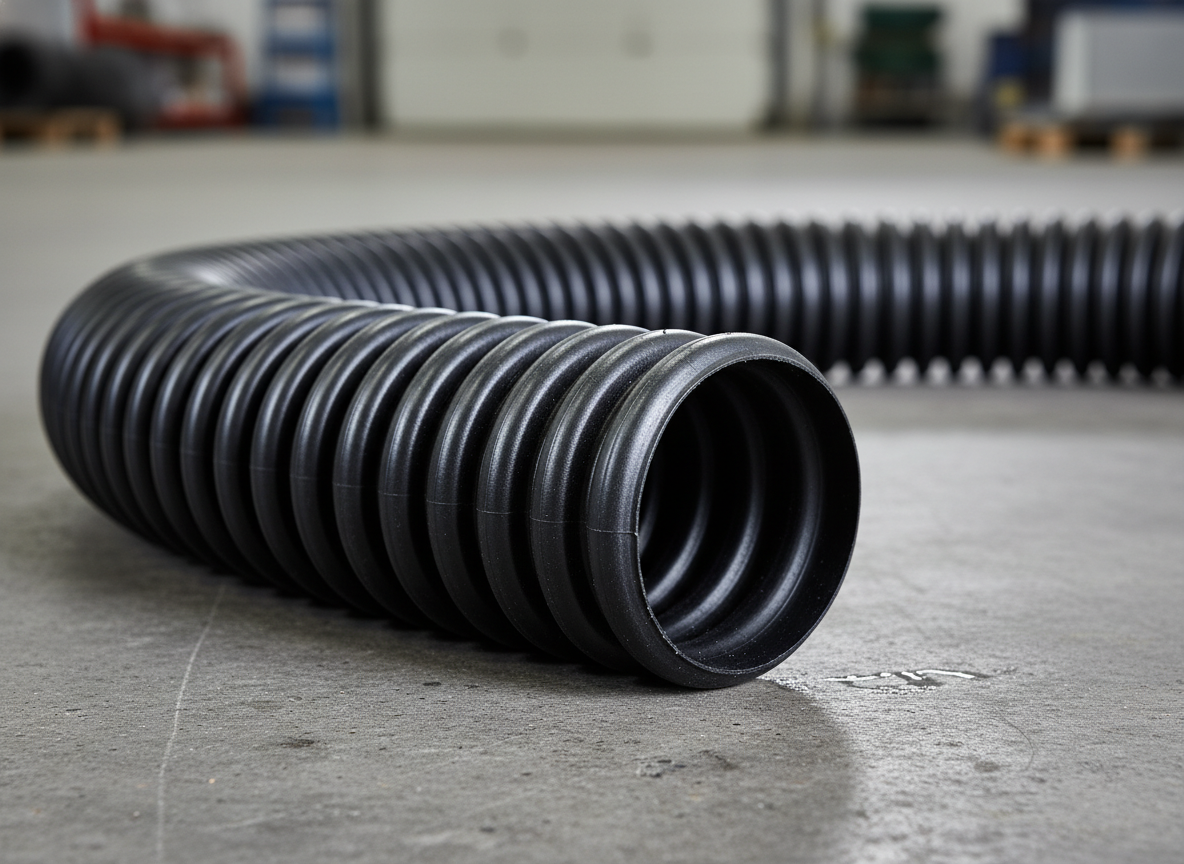
For deep railway platform drains, double-wall corrugated HDPE pipe (like Techdreno DW) is the solution that meets the structural, hydraulic, and durability requirements of the application.
The double-wall corrugated HDPE pipe with a minimum stiffness of SN8 withstands the load of the TB-360 type train (heavy-haul railways) with cover depths starting from 0.8 m, as verified by DNIT 093/2016-EM. The smooth inner wall offers lower hydraulic roughness than concrete, and HDPE is chemically inert to the acidic and ferruginous soils prevalent in Brazil’s interior — where the major railway corridors under construction and expansion are located.
What is the TB-360 type train and why does it change everything?
The TB-360 is the reference type train for heavy-haul railways in Brazil — such as the VALE, FIOL, FICO, and Transnordestina corridor railways. The number indicates the load per axle: 36 tons. For comparison, the standard road train (first-world highways) operates with much lower loads.
This load is transmitted to the ground dynamically and cyclically — each axle passes, compresses the structure, and moves on. Drains beneath the platform indirectly absorb this load through soil pressure. An undersized pipe for this condition will slowly collapse, crack, or deform — and the signal appears as track instability, not pipe rupture.
Techdreno DW has an SN8 ring stiffness (≥ 800 N/m²), which ensures resistance to collapse with cover depths from 0.8 to 6.0 m under heavy traffic. For heavy-haul railways with TB-360, this is the minimum parameter to specify — and it must be verified for each combination of DN (nominal diameter) and cover depth in the manufacturer’s technical catalog.
Why does concrete pipe have limitations in Brazilian railways?
Concrete pipe (according to ABNT NBR 8890) is a well-established solution but has specific limitations for the Brazilian railway context:
- Acidic and sulfated soils: The Oxisols and ferruginous soils predominant in the Cerrado, Atlantic Forest, and the Center-West and North corridors of Brazil often have a pH below 5.5. Concrete is attacked by sulfates and acidity — degradation that is not externally visible until it compromises the structure.
- Joints: Concrete pipes have limited length (typically 1–2 m), requiring many joints in a longitudinal drain. Each joint is a point for fine material infiltration — exactly what should be avoided.
- Weight and logistics: In railway works in remote areas (FIOL, Transnordestina), the weight per meter of concrete significantly increases transportation costs and installation time.
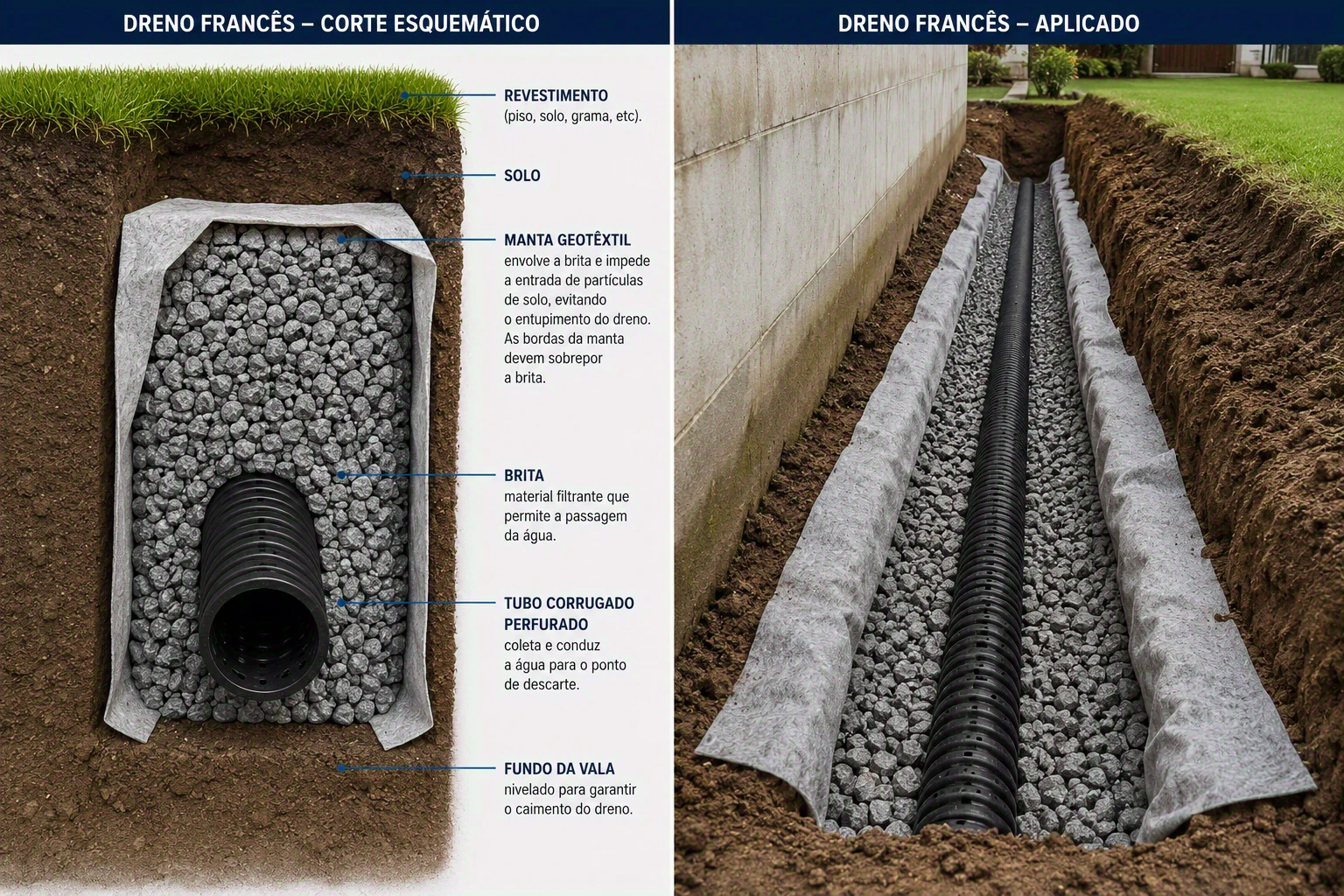
- No integrated filtering envelope: Concrete does not have a factory-made solution equivalent to Techdreno KC — the envelope must be installed separately in the field.
This does not mean concrete is never applicable — in neutral soils, large diameters, and locations with local availability, it can be competitive. However, the technical comparison must consider these factors, not just the initial cost of the pipe.
What does DNIT’s ISF-210 say about railway drainage pipe?
DNIT ISF-210 is DNIT’s specific service instruction for railway platform drainage. It defines the design, material, and installation criteria for permanent way longitudinal and transverse drains.
An important point in ISF-210: the standard explicitly allows the use of “pipe + manufacturer-standardized drainage fabric” as an integrated solution for deep platform drains. This directly covers Techdreno KC — corrugated HDPE pipe with a geotextile filtering envelope integrated directly during manufacturing.
In practice, this means the designer can specify Techdreno KC as a single solution for the longitudinal deep drain — without needing separate specifications for pipe and geotextile, without field envelope assembly, and without quality variations between sections of the work.
When to use Techdreno DW and when to use Techdreno KC?
Both solutions address distinct demands of railway drainage:
- Techdreno DW (double wall, SN8): suitable as a deep longitudinal and transverse drain in permeable soils, where the pipe needs to withstand structural load but the surrounding environment does not pose a risk of fine material migration into the pipe. Also for culverts crossing under the platform with TB-360 loads.
- Techdreno KC (with integrated filtering envelope): suitable in fine soils — clayey, silty, ferruginous — where there is a risk of clogging due to particle migration into the pipe. The integrated filtering envelope eliminates the need for separate geotextile in the trench. It is the product that ISF-210 classifies as “pipe + manufacturer-standardized fabric.”
In clayey cuts — which represent a significant portion of alignments in tropical soils — KC is the choice that protects the drain throughout the track’s service life, not just in the initial years.
What is the service life of an HDPE pipe in railway drainage?
International technical literature documents a service life of 50 years or more for corrugated HDPE pipes under equivalent conditions. HDPE is inert to acids, sulfates, and chlorides — the main chemical degradation agents in Brazilian tropical soils.
Concrete pipe has an equally long service life in neutral soils, but in acidic soils (pH < 5), it undergoes carbonation and sulfate attack that progressively reduces the wall's useful thickness. Railways with a design life of 50 years in Cerrado or Atlantic Forest regions need to consider this degradation in their dimensioning.
An important caveat: the service life of any drain also depends on the maintenance of the platform’s surface drainage — clogged ditches and transverse culverts force all water into the deep drain and can overload the system.
How to specify the correct pipe in a railway project?
The parameters that define the specification of drainage pipe in railway projects:
- Soil type: Fine clayey/silty soil → KC with filtering envelope; granular soil → DW double wall.
- Planned cover depth: Calculate soil load + railway surcharge to verify minimum required SN. For TB-360 with 0.8–6.0 m cover depth, SN8 is the starting parameter — check Techduto catalog for each DN.
- Soil pH and chemistry: Soils with pH < 5.5 or presence of sulfates → HDPE (concrete not recommended).
- Applicable standard: Check ISF-210 and other DNIT instructions for the specific railway. Projects in partnership with VALE, VLI, or RUMO have complementary specifications.
- Diameter: Calculated by design flow rate (Manning’s equation), considering n ≈ 0.009–0.011 for HDPE versus n ≈ 0.013 for concrete — HDPE allows for a smaller diameter for the same flow rate.
The Techduto engineering team can support the technical specification of railway drains, cross-referencing soil parameters with the product catalog and load verifications for the project’s reference composition.
Frequently asked questions
Yes, with the correct specification. Techdreno DW with SN8 ring stiffness (≥ 800 N/m²) withstands TB-360 type train loads with cover depths starting from 0.8 m, as verified by DNIT 093/2016-EM. The combination of DN, cover depth, and soil type must be verified in the manufacturer’s technical catalog for each specific project.
Techdreno KC is a corrugated HDPE pipe with a geotextile filtering envelope integrated directly during manufacturing — it eliminates the need for separate geotextile and sand layers in the field. It is indicated for fine soils (clayey or silty) where there is a risk of clogging due to particle migration. DNIT ISF-210 explicitly allows “pipe + manufacturer-standardized drainage fabric” — exactly what KC delivers.
Concrete can be used in neutral soils and with good local availability. However, in the Brazilian railway context — with acidic soils of the Cerrado, works in remote areas, and a 50-year design life — HDPE offers advantages in chemical durability, logistics (approx. 10x lighter), and fewer joints (long coils vs. 1-2 m sections). Each joint is a potential point for fine material infiltration.
The main reference is DNIT ISF-210 (DNIT Railway Service Instruction), which deals with platform drainage. Additionally, DNIT 093/2016-EM establishes requirements for corrugated HDPE drainage pipes, including ring stiffness (SN) verifications for different cover depths and traffic loads.
It depends on the product. The standard Techdreno DW does not have a filtering envelope — in granular soil, it can be installed directly. In fine soil (clay, silt), a filtering envelope is necessary to prevent particle migration. Techdreno KC solves this with its factory-integrated envelope, eliminating field installation variability and the cost of separate geotextile and sand.