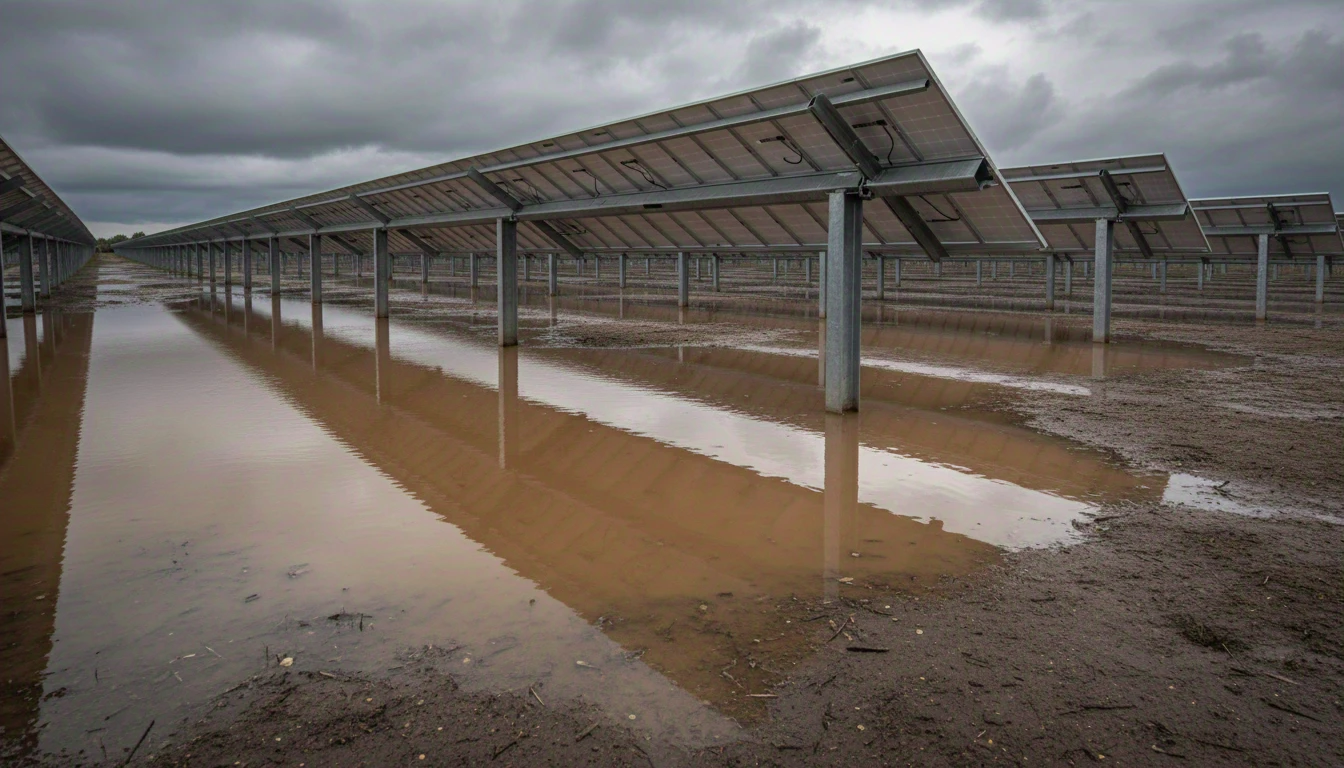


Heavy rains can cause flooding, but they can also damage pavement structures, reducing their
and leading to environmental impacts and accidents, especially on streets and highways. Pavement drainage is essential to minimize these problems.
With the growth of cities, green areas (gardens, parks, squares, green corridors) and permeable areas on public and private land have become mandatory by law. To prevent damage, a common solution is pavement drainage using permeable solutions.
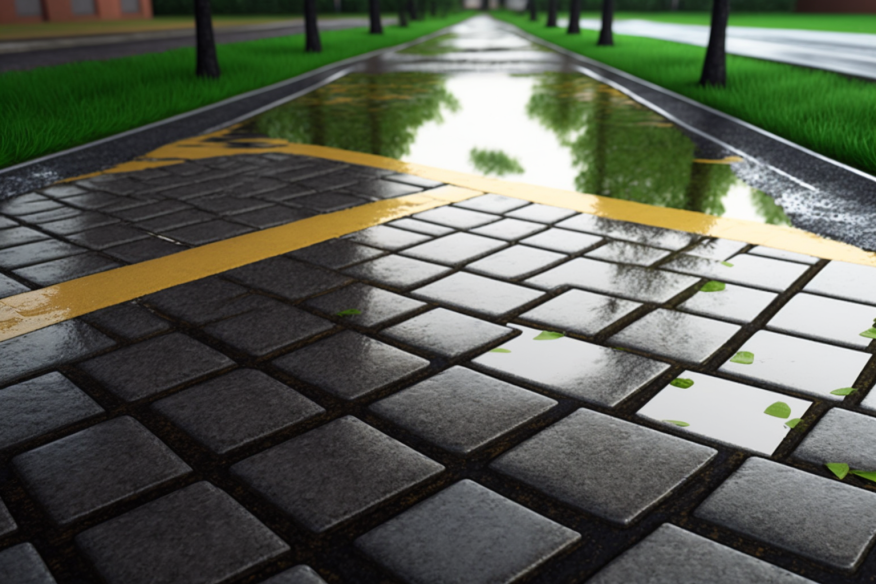
Permeable pavements are made with materials such as porous asphalt, permeable concrete, interlocking pavers, crushed stone, and permeable paving, as well as reservoirs. They can be used in different types of construction, from residential to public areas such as sidewalks, parking lots, patios, backyards, and plazas.
Types of Permeable Pavement
| Type | Characteristic | Typical use |
|---|---|---|
| Porous asphalt | Larger particle size, ~20% voids | Streets, bike paths, large parking lots |
| Permeable concrete | Less sand, internal voids that allow water to infiltrate | Sidewalks, patios, light traffic |
| Interlocking drainage pavers | Gaps between the pavers allow water to drain downward | Squares, sidewalks, parking lots |
| Concrete with joints/openings | Openings filled with gravel or grass | Green spaces and parking lots |
Pavement drainage: how does it work?
In addition to providing surface runoff for rainwater, pavement drainage must be designed with the load on the soil in mind to ensure its strength, efficiency, and durability, since the pavement serves as the “entry point” for the water conveyance system.
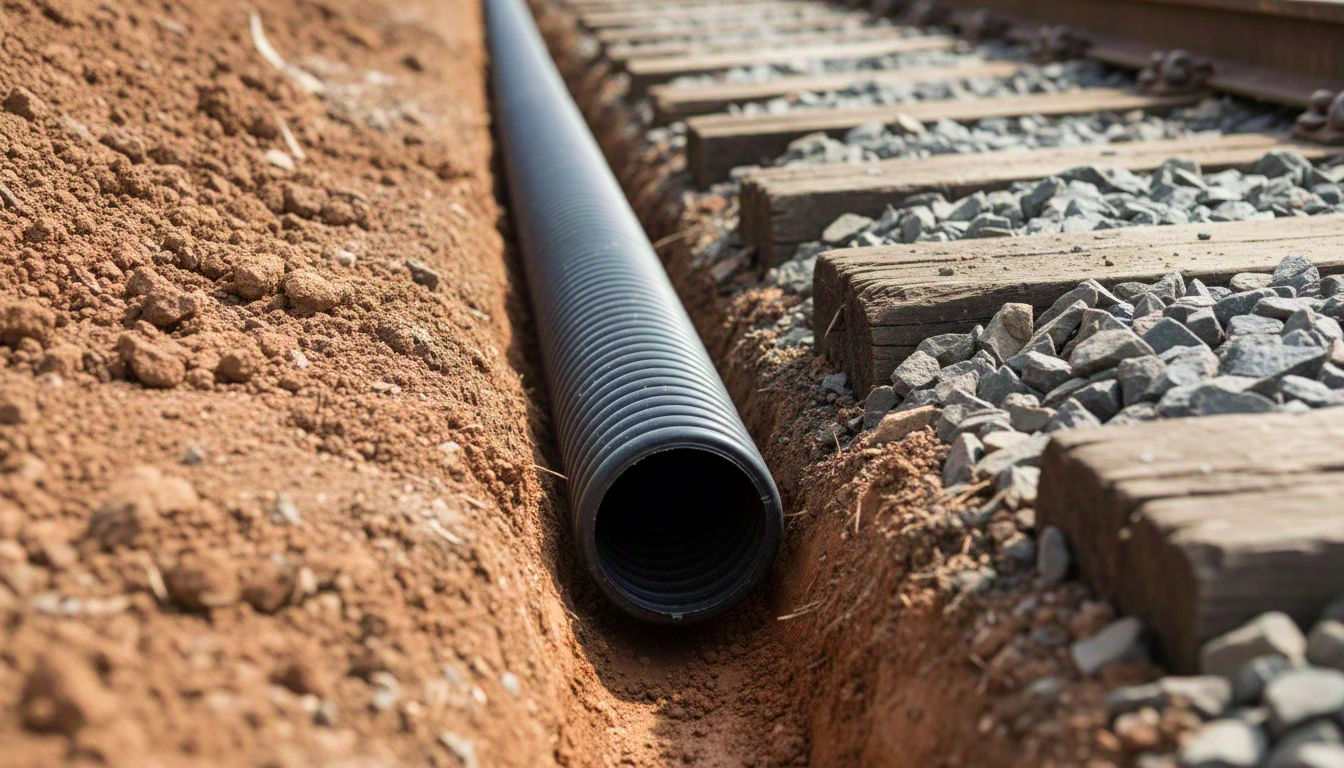
In pavement drainage, the subgrade and reinforcement soil are compacted, in addition to the leveling stage, if necessary. Next, the drainage system is installed using corrugated pipes, the geotextile mat is laid, and the gravel layer is applied and compacted. Finally, the curb and gutters are constructed, and the selected type of permeable pavement is laid according to its specific requirements.
In practice, permeable pavement is constructed in layers—from the surface down:
- Permeable surface (porous asphalt, permeable concrete, or interlocking drainage paving) — through which water enters;
- Bedding layer (sand or crushed stone);
- Gravel base and subbase — act as a reservoir and conduct water;
- Geotextile membrane — separates the layers and filters out fine particles;
- Corrugated drain pipe — collects and channels excess water to the drainage system;
- Compacted subgrade — the support base for the entire system.
Pavement drainage with permeable surfaces: what are the advantages and benefits?
- Sustainability: eliminates environmental and urban problems that can arise due to soil sealing. Additionally, permeable pavement facilitates direct infiltration into underground aquifers, while also filtering out contaminants—primarily solids—present in the water.
- Flood reduction: with infiltration from the surface, drainage systems receive less rainwater, which is easily absorbed by the soil, preventing waterlogging and flooding.
- Cost reduction: by reducing damage caused by rain, the use of permeable pavements helps lower repair costs. In some cases, the materials are reusable, and no cement or mortar is required.
Pavement drainage also reduces the need for local micro-drainage work, improves vehicle traction (due to its rough texture), prevents accidents caused by slipping, and enhances soil quality, leading to more productive land.
Pavement drainage is with Techduto!
If you’re planning to invest in drainage with permeable pavers, count on our products!
Techduto offers the most comprehensive solution for stormwater drainage, made from completely non-toxic and environmentally friendly materials.
Our Techdreno NBR and Techdreno DW lines were developed to offer excellent absorption capacity and facilitate water flow, supporting the weight of the soil with flexibility; Techdreno NBR is ideal for creating curves without the need for connections.
In addition, we offer the Bidim®️ geotextile mat, a 100% polyester nonwoven fabric that is permeable and durable, allowing for better water drainage while retaining soil particles.
Contact us to learn more about our solutions!