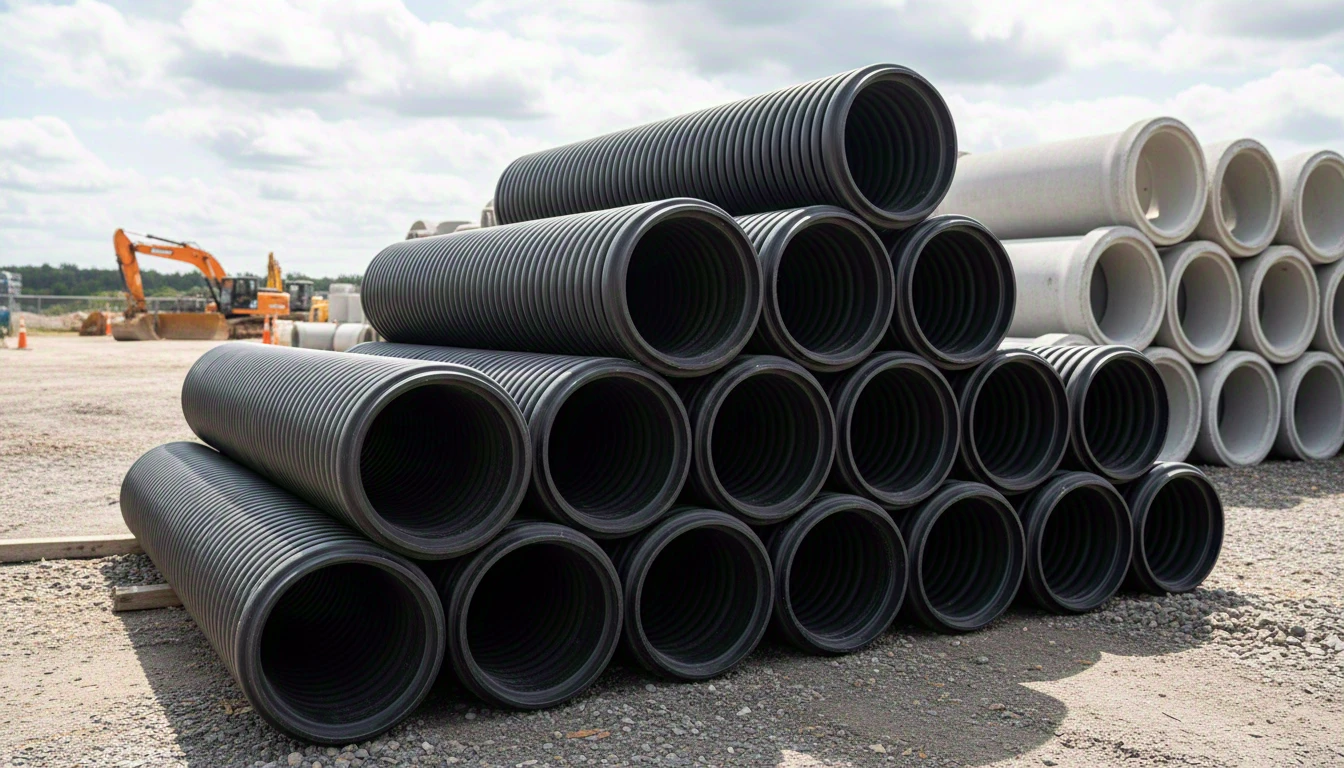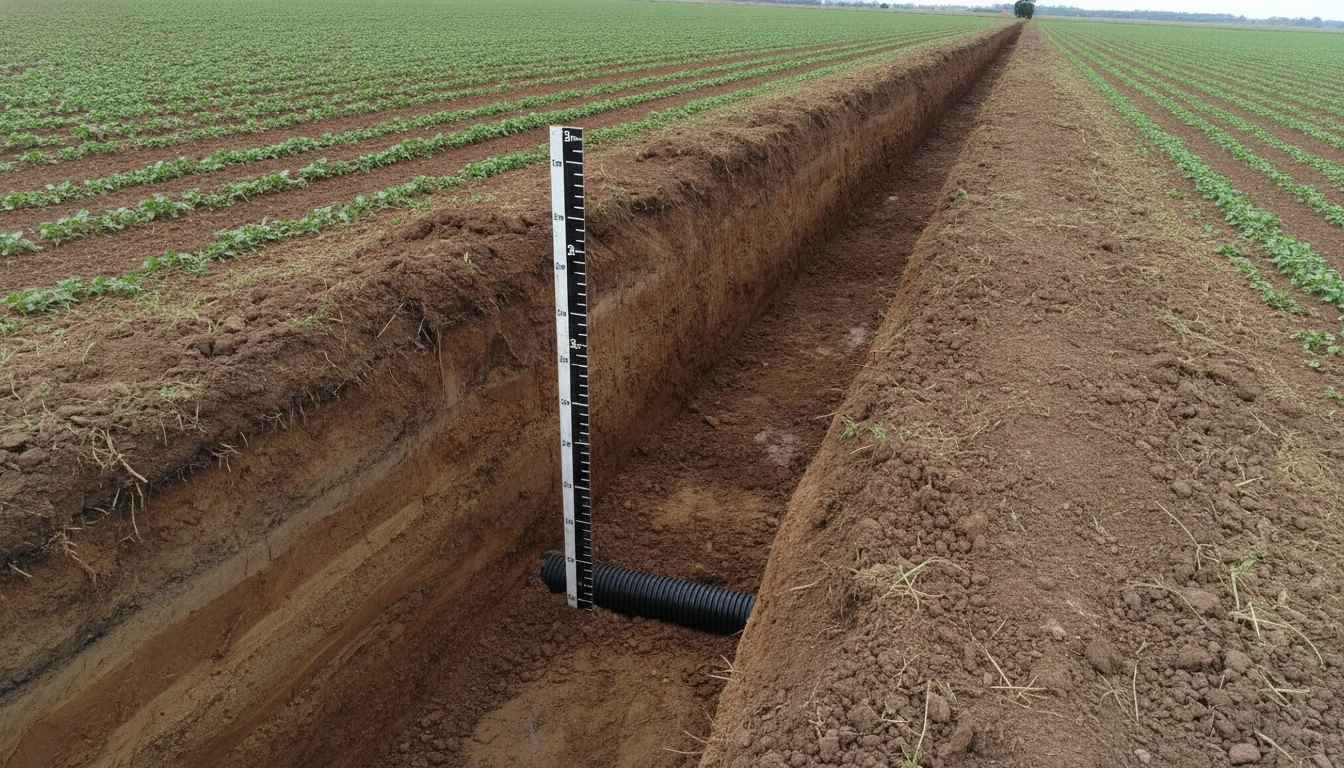


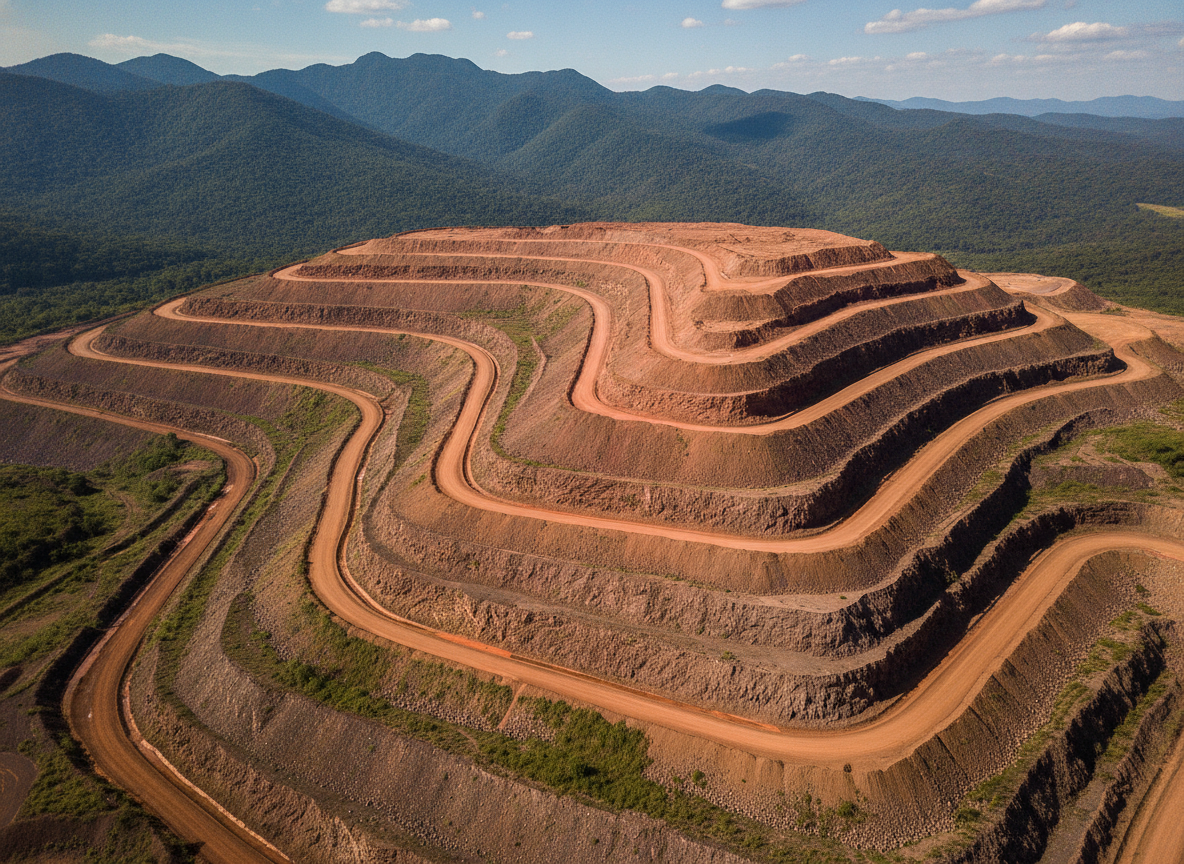
Tailings pile drainage removes infiltrated water before it saturates the mass, eliminates shear strength, and causes failure. Perforated HDPE pipes at the base, drainage geocomposite in the inner layers, and filter geotextile at the outlets form the system that ensures stability and regulatory compliance.
How does tailings pile drainage work?
A tailings pile accumulates rock and soil removed to access the ore. Without efficient base drainage, water raises pore pressure, reduces the friction angle, and increases the risk of liquefaction — the central mechanism of failures cataloged by ANM. Law 14.066/2020 and ANM Resolution 95/2022 require a detailed drainage plan for all mining solid waste disposal structures.
What is a tailings pile and why does it need drainage?
Tailings are the material removed to expose the deposit — soil, rock, and clay of no economic value. In large Brazilian mines, piles reach tens of meters in height and millions of tons. Rainwater infiltrates this heterogeneous mass and, without a controlled outlet, accumulates pressure in the material’s pores.
Elevated pore pressure reduces effective stress and, consequently, shear strength — the physical mechanism that keeps the pile stable. The risk of liquefaction increases in saturated fine materials (clays, silts). Base drainage is the primary control: it removes water before it accumulates.
What are the components of the base drainage system?
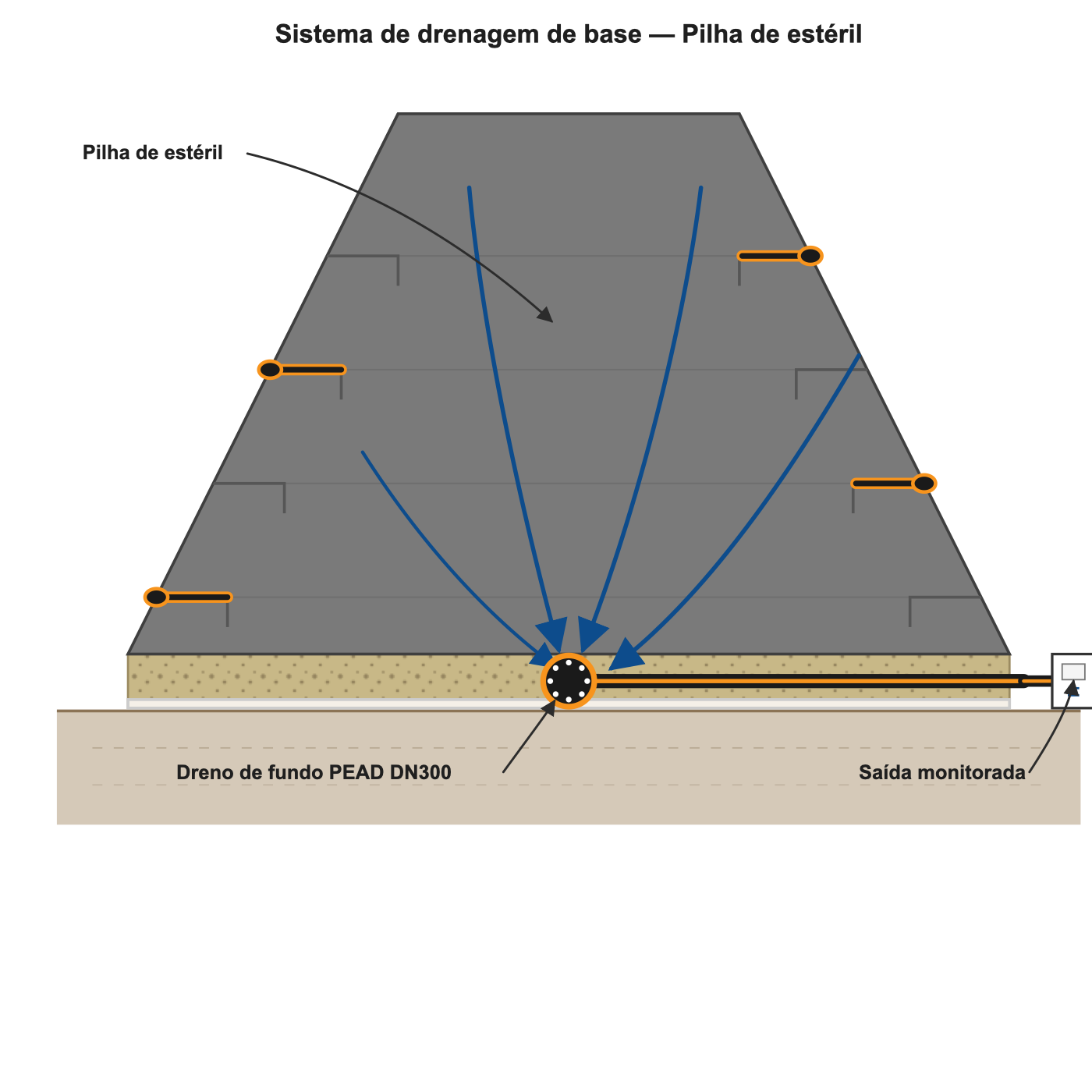
A tailings pile base drainage system has three functional layers:
- Bottom drain (base): perforated HDPE pipe DN200–400 installed longitudinally under the pile before stacking begins, on a gravel cushion or drainage geocomposite. It conveys collected water to a monitored outlet.
- Drainage cushion: a layer of gravel or drainage geocomposite with filter geotextile between the tailings and the drain. It distributes flow and prevents fines migration into the pipe (chimney filter).
- Horizontal relief drains: perforated HDPE pipes installed on bench berms to intercept the water table and reduce pressure at each slope level.
The double-wall HDPE pipe’s Manning coefficient (n ≈ 0.009–0.011) ensures flow capacity with a smaller diameter than concrete, reducing cost and weight in installations on uneven terrain.
What changes in the system when dry stacking is adopted?
Dry stacking processes tailings or waste to reduce moisture before stacking, eliminating liquid tailings dams — a disposal method prohibited in upstream mode by Law 14.066/2020. The need for drainage changes, but does not disappear:
- Residual water from the “dry” material still needs collection at the base — a drainage geocomposite under the pile replaces the gravel layer with a logistical advantage in remote areas.
- Rain falling directly on the pile requires a surface drainage system (perimeter ditches, downspouts, energy dissipators) to prevent erosion and fines transport.
- Filter geotextile at the outlets prevents fines from contaminating the monitoring point.
What products to use at each point of the pile?
| Pile point | Problem | Recommended product |
|---|---|---|
| Base / bottom | Pore pressure buildup, liquefaction | Perforated HDPE pipe DN200–400 + drainage geocomposite |
| Intermediate layers (berms) | Perched water table between benches | Horizontal relief drains — perforated HDPE pipe DN100–200 |
| Outlet filter | Fines migration, clogging | Filter non-woven geotextile (Bidim or equivalent) |
| Bench surface drainage | Erosion, fines transport | Ditch with geocomposite + smooth HDPE pipe downspout |
| Conveyance to monitoring point | Heavy equipment traffic over the pipe | Techdreno DW SN8 (certified ring stiffness) |
What does Brazilian regulation require?
Three regulatory instruments define the obligations for mining waste disposal structures in Brazil:
- Law 14.066/2020 — prohibits construction, raising, or expansion using the upstream method; requires the decommissioning of existing dams in this mode; defines the entrepreneur’s civil and criminal liability.
- ANM Resolution 95/2022 — regulates Law 14.066; requires a Dam Safety Management Plan (PGSB), periodic audits, instrumentation, and pore pressure monitoring.
- GISTM (Global Industry Standard on Tailings Management, 2020) — an international standard adopted by mining companies listed on international stock exchanges; requires “zero fatal incidents” and documented base drainage as a critical safety control.
The drainage plan must specify the collection system, design flow rates, filter criteria (geotextile × tailings granulometric compatibility), and monitoring of outlet points. Product technical documentation — ring stiffness certificates SN, geotextile test reports according to ABNT NBR 13246 — is part of the dossier required in ANM audits.
Frequently asked questions
Tailings piles receive solid rock and soil; tailings dams originally received wet slurry. With the prohibition of the upstream method (Law 14.066/2020), dry stacking brings the two closer: both now require base drainage with perforated HDPE pipe and a filter cushion, but tailings piles have lower initial moisture content.
Techdreno DW with SN8 ring stiffness (≥ 800 N/m²) can support cover depths from 0.8 m to 6.0 m with heavy traffic, according to DNIT 093/2016-EM. For installation under large equipment with minimal cover, consult the Techduto engineering team for specific load verification.
A chimney filter is a vertical layer of granular material or geotextile that intercepts internal flow before it reaches the drain, retaining fines. In a tailings pile, it is installed at the transition between fine tailings and the base drain, preventing pipe clogging due to particle migration.
ANM 95/2022 does not specify brands or materials, but requires the drainage system to be designed by a qualified technical professional, with calculation memos, documented filter criteria, and monitoring of outlet points. Products with technical certification (ring stiffness tests, permeability, and chemical compatibility) facilitate the audit dossier.
In many projects, yes. The drainage geocomposite (3D HDPE core + filter geotextile) offers hydraulic transmissivity equivalent to a 15–30 cm gravel layer, with a decisive logistical advantage in remote mines: lower transport weight and simpler mechanized installation. It requires geotechnical design to verify compatibility with specific loads.