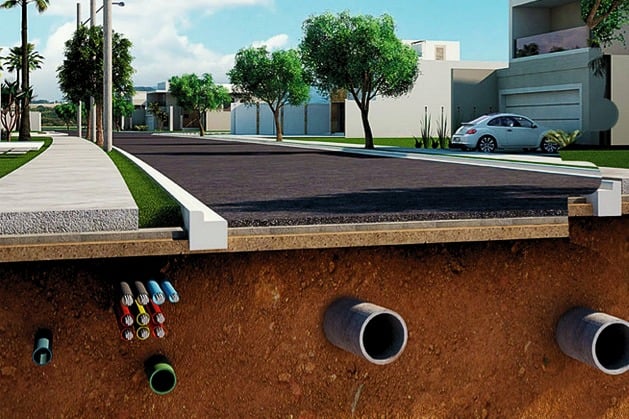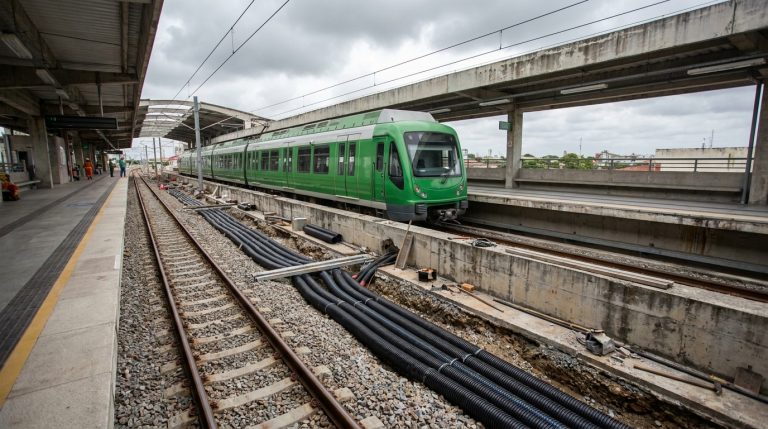


The most modern construction projects require that their electrical and/or telecommunications infrastructure be installed out of sight, hidden within walls or underground. However, due to the risks involved, electrical cables must be protected, as they often run for hundreds of meters underground. But how can this electrical system be protected so that the wires do not suffer damage?
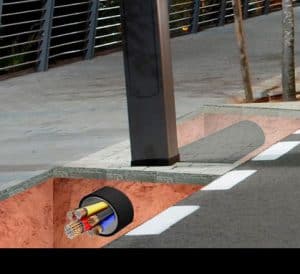
That’s where the Techduto line of conduits comes in—corrugated conduits made of HDPE (High-Density Polyethylene). They were specially developed to protect electrical cables installed in underground environments.
Key advantages
Corrugated conduits are unique because, among their many advantages, they protect electrical cables primarily against:
- Chemical attacks from elements present in the soil—otherwise, the product could even dissolve in reaction to agents present in the ground;
- Mechanical stresses caused by underground movements and heavy objects that may pass over the surface immediately above the installation. In this case, we are talking about withstanding loads ranging from passing cars to ore tractors in mining yards. Of course, these are different products, installed at different depths;
- Enormous flexibility: the product settles into the ground and conforms to its surroundings as the terrain shifts. This is important because when PP (polypropylene) is used in the composition, the material can break or crumble during this settling process, compromising the product’s functionality.
These advantages in cable protection are explained by the following reasons:
- HDPE is a highly inert polymer, meaning that the vast majority of chemical agents do not affect it;
- The corrugated profile of the Techduto line of conduits was designed to be as lightweight as possible, facilitating installation. This design allows for any type of bend, in addition to withstanding high loads. This relates to mechanical concepts such as "moment of inertia" and "distributed load," among others.
For projects requiring even greater mechanical strength and ease of cable routing, there is the double-walled Techduto DW: the corrugated outer layer ensures crush resistance, while the smooth inner layer facilitates cable installation.
Potential problems with conduits for protecting electrical cables
There are several issues with non-compliant conduit lines. The Techduto line of cable protection conduits features 450 N conduits (Techduto SD), based on the European standard, and 680 N conduits (Techduto NBR), in accordance with ABNT NBR 15715. However, there are products on the market that are nominally rated at 450 N but, in practice, have less than 250 N of strength. The result is products that end up “collapsing” (unable to withstand the weight) during installation, rendering them useless.
In addition to this main problem, there is another very serious one: the use of raw material derived from pesticide packaging. This material can contaminate the soil and seriously harm those who handle it. It retains a certain level of toxicity, but since there is no effective control, it continues to be used in various applications (not just in pipes) due to its low cost. And the problem doesn’t stop there: for the most part, these containers are made of two materials (usually HDPE and polyamide, in a process called CO-EX), which do not blend through normal heating of the product, requiring the addition of a special additive—whose long-term behavior is uncertain. The risk is that the final product will deteriorate much faster than one made solely from HDPE. By using products of this origin, you could jeopardize your entire project.
Best practices for underground installation
Choosing the right conduit is half the battle; the other half is installing it correctly. For a safe and code-compliant underground electrical installation, note the following:
- Proper depth: adhere to the minimum depth requirements based on voltage and local utility standards—generally deeper for medium voltage than for low voltage;
- Bedding and backfill: lay the conduits on a layer of sand (free of sharp stones) and backfill them in the same manner, compacting in layers to distribute the loads;
- Sealing of joints: ensure the joints are watertight using DutoSeal Tape, preventing water and fine particles from entering the conduit;
- Warning tape: install warning tape approximately 20 cm above the conduits to alert workers to the presence of the electrical network during future excavations.
Conclusion
Thus, Techduto conduits can be used for any application requiring protection of embedded electrical and telecommunications cables. By using them, there is no need to worry about damage to electrical cabling caused by external factors, ensuring a more cost-effective and headache-free project.