

Learn how to install drainage for a beach tennis court and ensure that matches can be played on both rainy and sunny days
No, you no longer have to wait for the weekend or a holiday to go to the beach and play beach tennis with friends. In today’s article, you’ll learn how to build your own court with all the useful information you need to play matches like a pro, from preparing the ground to the beach tennis court drainage system.
Since this is a sport played on sand, the construction process involves some specific considerations, such as leveling the ground, choosing the right type of sand, and even determining the best way to transport the equipment to the site. Not sure where to start? In the guide that Techduto has prepared, you’ll be able to clear up all your questions. Check it out!
What is Beach Tennis?
Before we start talking about the construction of the court itself, it’s worth explaining what Beach Tennis is.
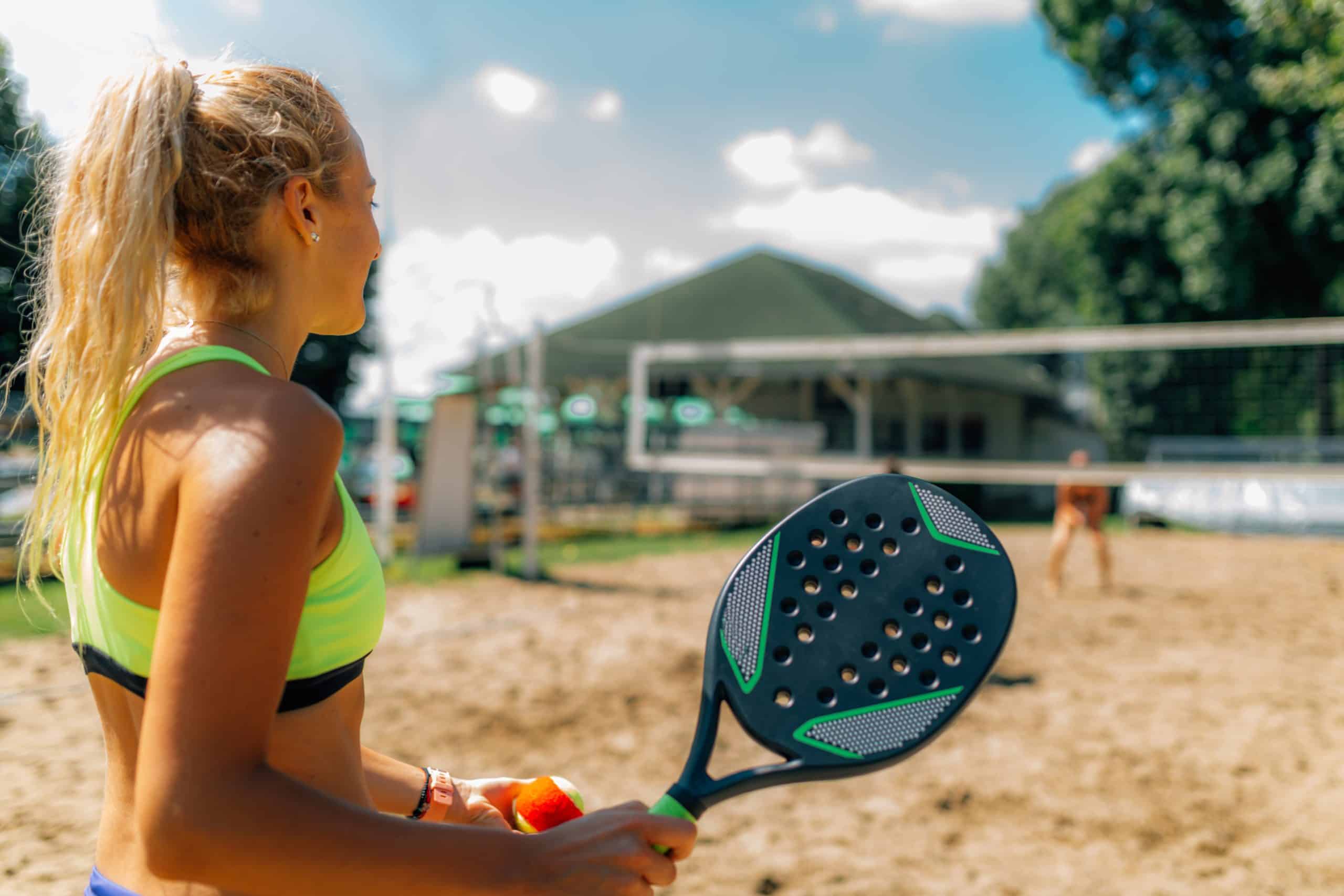
In principle, the sport is very similar to frescobol, but it’s played on a beach sand court divided by a net similar to a volleyball net. The sport has a similar objective to tennis, which is to hit the ball over the net to your opponent using a specific racket, without letting the ball land on your side of the court. The activity can be played by a single player or in doubles.
Commonly known as beach tennis, the sport was created in 1987 in Italy, but it wasn’t until 2008 that it arrived in Rio de Janeiro and began to gain popularity in other Brazilian coastal cities. Currently, the sport is a professional discipline, regulated by the Brazilian Tennis Confederation.
How to build a beach tennis court?
Now that you understand what beach tennis is, it’s time to learn how to make the most of the sport without having to wait for a court at the beach or in the park to open up so you can play. In fact, given the sport’s popularity in Brazil, dedicated courts are becoming increasingly common, whether private or designed to serve athletes.
The fact is that building a beach tennis court can be a profitable business, provided certain rules are followed, as outlined below.
Prepare the ground
The size of a beach tennis court can vary between 16 meters long by 4.5 meters wide or 16 meters long by 8 meters wide. What will determine the choice of one dimension or the other is whether the matches played on the court will be singles—that is, with only one player on each side—or doubles.
As for the depth, the court excavation should be 50 to 60 cm deep, which should be filled with 25 cm of sand.
Prepare the beach tennis court drainage system
Of the total excavation depth, 30 to 40 cm are occupied by the beach tennis court drainage system. It serves to drain excess water from the ground, preventing the court from flooding and compromising matches.
The most common beach tennis court drainage system is the herringbone pattern, where smaller HDPE drainage pipes are connected to a central conduit (usually of larger diameter to avoid constricting the system), which is responsible for directing water seeping into the ground to the drainage network. Its major advantage is providing greater flow capacity for the collected water volume, thus preventing the sand from becoming waterlogged.
Another point of attention is the connection fittings—including caps, straight connectors, and end joints for creating "Y" or "T" configurations—which must be correctly sized for the system. This is because there is a risk of disconnection between them, which would allow soil to enter and potentially block the entire system. Techduto has an exclusive system with locks that do not come loose and allow for much faster assembly.
It is also essential to use high-quality geotextile (Bidim), which serves two purposes. One is to filter out the soil particles that will come with the drained water into the pipe so they do not clog its pores and block the system. The other is to separate the soil from the sand, preventing them from mixing.

Herringbone Drainage System
The drainage system gets its name because the layout resembles the skeletal structure of a fish, where the main conduit represents the spine and the lateral drains represent the bones. And although this is the most commonly used drainage layout on sports fields due to its rapid water runoff, the court’s drainage system can also be of the parallel type.
Care must be taken with the spacing, which should not exceed 2.5 meters due to the shallow depth at which the drains are installed (Techdreno
). This is because underground absorption occurs in a pattern of "absorption arcs" between the underground drains. So, when placed too far apart, you will notice water pooling on the surface right in the middle between the installed drain lines. This compromises the entire system.
Also, be very careful with the drainage bed and the slope. On average, a 1% slope is sufficient for this type of installation, but it may vary depending on the project. Now, the bed where the pipe will be placed needs to be even, without any “bumps,” because if there are any beneath the pipes, they can disrupt the flow and even damage the pipes depending on how they are sized and installed.
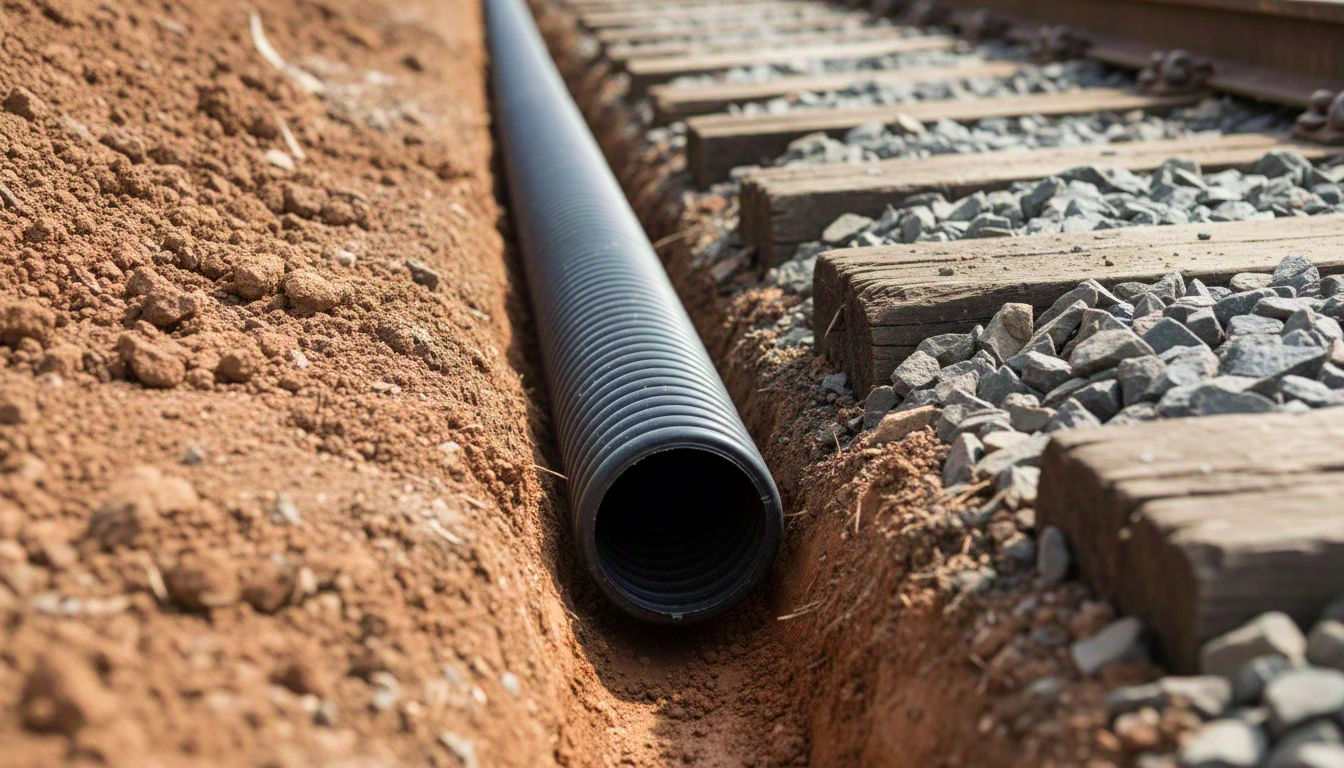
As for the drainage pipes used in the Beach Tennis court drainage system, it is recommended that they be made of HDPE (High-Density Polyethylene), since this is a non-toxic, flexible, resistant, and durable material.

Drainage pipes (Techdreno) can be installed covered with a geotextile liner (Bidim) directly in the trench if a less efficient and cheaper system is chosen. However, for more effective drainage (typically required on sports fields), the trenches that receive the pipes are first lined with the open geotextile fabric, then filled with gravel, with the pipes placed in the middle; this is then covered with gravel, and the geotextile fabric is closed over the top. In this system, you achieve a significant increase in water flow capacity, as both the drainage pipes and the spaces between the gravel stones can accumulate water. This is the ideal scenario, as it provides much faster drainage than the lower-cost option.
When combined, HDPE pipes and geotextile fabric become excellent drainage solutions. And, when properly installed, they result in an effective, long-lasting drainage system.
Choose the type of sand
There are two types of sand most commonly used in the construction of beach tennis courts: washed sand and treated sand. The first is the same sand used in construction, while the second undergoes a treatment that prevents the growth of fungi and bacteria, making it easier to sanitize.
When choosing the type of sand, consider the grain size of the product. The finer the sand, the more comfortable the sport will be for athletes.
Determine the amount of sand
To calculate the amount of sand you’ll need, remember that a beach tennis court is at least 16 meters long by 4.5 meters wide. Also, keep in mind that it has a depth of 50 to 60 cm, reserved for the beach tennis court drainage system. Of this total, 25 cm must be filled with sand. Therefore, the estimate is that you will use about 55 m³ of sand.
Time to equip the space!
With the structure designed, it’s time to equip the court. To do so, various pieces of equipment are needed, such as:
- Poles to support the net: the most suitable are those made of galvanized steel, as they are more durable;
- Polyester lines to mark the boundaries;
- Beach tennis net: these are generally 9 m long by 1 m wide;
- Protective nets: although not mandatory, they prevent balls from leaving the court and getting lost;
- LED floodlighting: another optional item, but one of extreme importance. In addition to adding charm to the Beach Tennis court, it also allows the sport to be played at night. Note that we offer Techduto pipes for making this underground connection to the floodlights
How can Techduto help with the construction of your beach tennis court?
As you can see in this article, building a beach tennis court is relatively easy, but it requires planning. And among the most important steps is the beach tennis court drainage system, which promotes the rapid drainage of water that has seeped into the ground and allows matches to be played even on rainy days.
In this sense, Techduto acts as a facilitator for the construction of a functional and long-lasting court. We have already supplied products for hundreds (perhaps even thousands) of projects of this type and have also helped many who were at a loss seeking information on how to proceed. We are a Brazilian company specializing in the manufacture and supply of HDPE corrugated pipes for various construction projects. For beach tennis court drainage systems, we offer the techdreno and techdreno DW lines, effective solutions for controlling excess water on sports fields, highways, railways, plantations, and various other locations.
Flexible, non-toxic, and durable, they support the weight of the soil without compromising product quality and can be bent without the need for fittings. By default, they are available in diameters ranging from 50 mm to 250 mm, but Techduto can also offer customized solutions to meet the needs of your project. Visit our website and check it out!