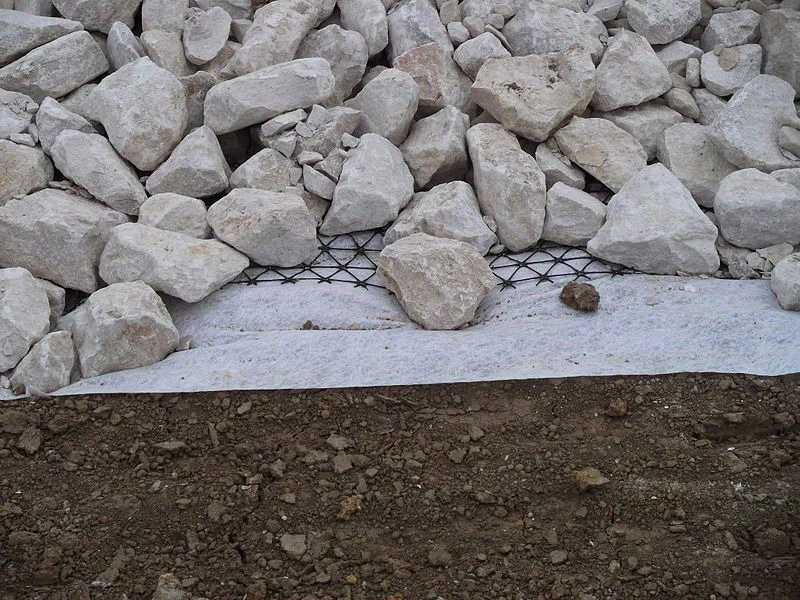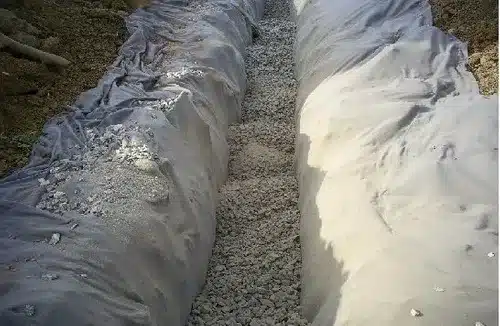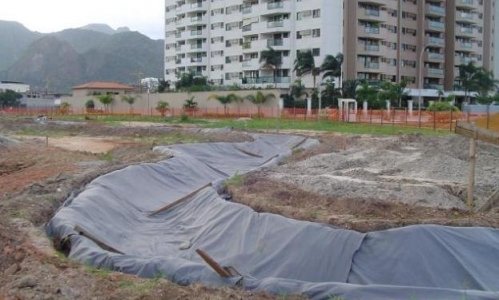


Geotextile mats (also known as filter fabrics) are permeable synthetic materials designed to improve soil properties. They can be used to filter, reinforce, separate, protect, and drain soils. Geotextiles are widely used in civil engineering for various applications, such as roads, ports, landfills, drainage, and many other projects.

Geotextile mats are typically made from polyester (PET) or polypropylene (PP) and are classified as either nonwoven or woven. They can also be found combined with HDPE structures to form so-called drainage geocomposites for various uses, such as retaining wall drainage, green roofs, and others, as is the case with the BidimDren product.
Types of Geotextile Mats
Woven Geotextile Mats are produced by interlacing fibers with parallel fibers, much like what is done in ordinary fabrics. They are typically used for reinforcing retaining structures, soil separation, and filtration. It is recommended, for example, for road construction and erosion prevention projects.
Non-woven geotextile fabric, on the other hand, is produced by depositing continuous filaments or short fibers. The fibers are bonded through chemical, thermal, or mechanical processes (such as needling) or a combination thereof. This type of geotextile mat is commonly used in applications related to filtration, separation, and drainage.
Nonwoven geotextile fabric manufactured with continuous filaments achieves greater strength with less material used, making it ideal for drainage applications. In these applications, “correct” filtration is essential, as insufficient filtration is as problematic as excessive filtration, which reduces the rate of liquid absorption.
Applications of Geotextiles

Geotextile mats have various applications. Such as:
- Road and Railroad Construction — in these projects, they are used to reinforce the soil for load distribution and consequently increase the durability of the structure. In addition to this application, they are also used as filters in the lateral drains necessary for removing excess water from the road;
- Sports fields and agricultural drainage — here, geotextile mats are applied both open-faced and in the form of “sleeves” wrapped around drainage pipes (Techdreno) to aid in filtering debris that could clog the pores of the drainage pipes;
- Channels and Slopes — in this application, geotextiles protect riverbanks from erosion. They are typically anchored artificially or naturally to act as filters. Both woven and nonwoven geotextiles are used in this application. In soils with coarser grain sizes, woven geotextiles are recommended because they have larger pores;
- Concrete curing — this is one of the most common applications of geotextile fabric, as this need applies to various types of construction projects. There are geotextile mats, such as the Bidim CC10, that are specifically designed to optimize this use. This mat is manufactured with two layers: one of an extra-thin plastic membrane and the other of geotextile. Since the plastic layer has carefully distributed pores, it allows water to pass through to the geotextile layer, which accumulates water and maintains the concrete at the ideal moisture level for an excellent curing process.
Properties and Characteristics of Geotextile Mats
The properties of geotextile mats are typically measured according to the requirements of various reference standards. The table below shows the values for the Bidim RT7, RT8, and RT9 models:
| Property | Standard | Bidim RT7 | Bidim RT8 | Bidim RT9 |
|---|---|---|---|---|
| Mechanical properties | ||||
| Tensile strength, wide range — break (L) | ABNT NBR ISO 10319 | 7 kN/m | 8 kN/m | 9 kN/m |
| Tensile strength, wide strip — elongation (L) | ABNT NBR ISO 10319 | > 50 % | > 50 % | > 50 % |
| Tensile strength, wide range — elongation at break (T) | ABNT NBR ISO 10319 | 6 kN/m | 7 kN/m | 8 kN/m |
| Tensile strength, wide gauge — elongation (T) | ABNT NBR ISO 10319 | > 50 % | > 50 % | > 50 % |
| Grab tensile strength — elongation at break (L) | ASTM D 4632 | 420 N | 500 N | 570 N |
| Grab tensile strength — elongation (L) | ASTM D 4632 | > 50 % | > 50 % | > 50 % |
| Grab tensile strength — tear (T) | ASTM D 4632 | 350 N | 430 N | 500 N |
| Grab tensile strength — elongation (T) | ASTM D 4632 | > 50 % | > 50 % | > 50 % |
| Trapezoidal tear — tear (L) | ASTM D 4533 | 190 N | 230 N | 240 N |
| Trapezoidal tear — rupture (T) | ASTM D 4533 | 170 N | 210 N | 220 N |
| Puncture | ASTM D 4833 | 240 N | 260 N | 290 N |
| CBR Puncture | ABNT NBR ISO 12236 | 1.1 kN | 1.3 kN | 1.5 kN |
| Hydraulic properties | ||||
| Permittivity | ASTM D 4491 | 2.5 /s | 2.2 /s | 2.0 /s |
| Water flow | ASTM D 4491 | 7450 l/min/m² | 6,850 l/min/m² | 6150 l/min/m² |
| Normal permeability | ABNT NBR ISO 11058 | 0.40 cm/s | 0.39 cm/s | 0.39 cm/s |
| Apparent opening | ASTM D 4751 | 0.212 mm | 0.212 mm | 0.212 mm |
L — longitudinal (manufacturing direction); T — transverse.
Purchasing Considerations
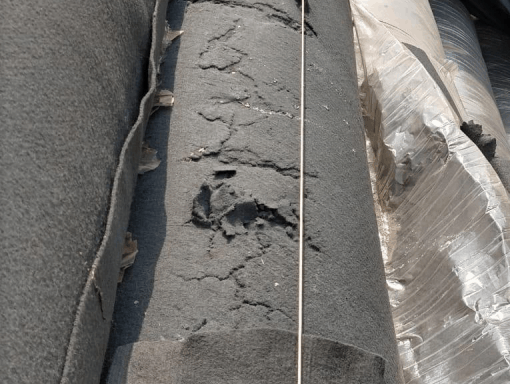
When purchasing geotextile mats, additional precautions must be taken, especially with those geotextiles produced with cotton fiber blends. These products are sold at very low prices but lack durability in the soil, as organic fibers undergo rapid degradation. Geotextiles made of pure materials, without cotton fibers—such as those made solely of polyester (PET) or polypropylene (PP)—ensure long-term durability for the product.
Furthermore, it is essential to verify the manufacturers’ technical data sheets and the test reports obtained from actual, in-house laboratories (unfortunately, there are companies that falsify reports, as they are not manufacturers but claim to be, or sell substandard products) that guarantee the product is tested for every batch produced.
How We Can Help
Techduto has been distributing Bidim brand products for several years. This company’s products are marked with the strength rating and model number, all directly on the product. In addition, they use continuous filaments and contain no organic fibers. As a result, Bidim products are highly durable and are ideal for use with our drainage pipes (Techdreno) and for various applications on your construction site.