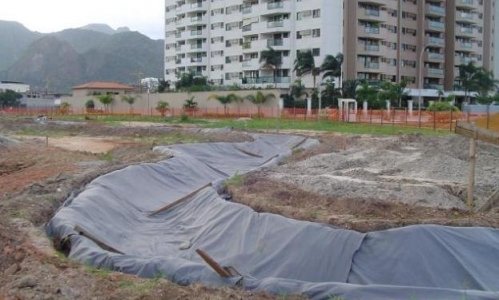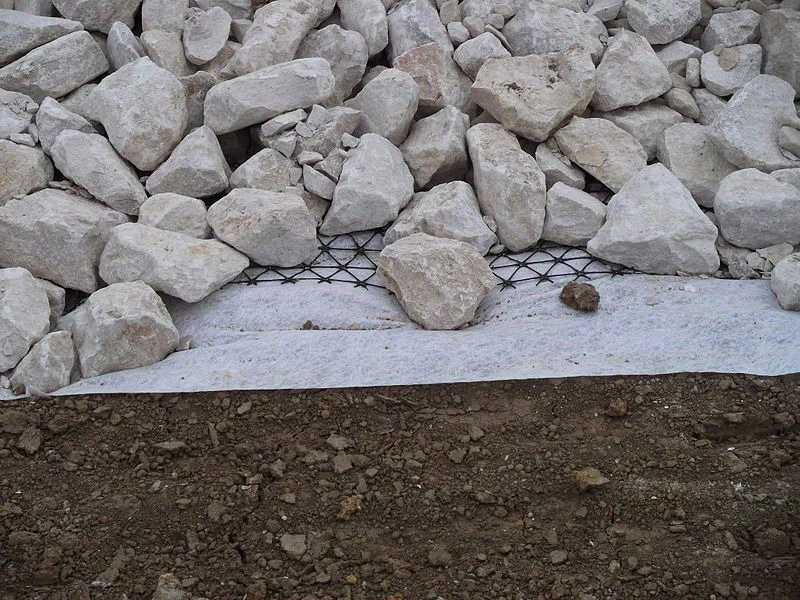

Geotextile fabric is a permeable nonwoven material used in conjunction with soil to help drain, filter, and reinforce the ground where it is installed, as well as to provide protection.

Extremely versatile, it can be used in road construction, landfills, drainage projects, and gardens. Its main purpose is to separate soil layers of different particle sizes while allowing water to flow freely.
This prevents soil damage and improves the property. Among its advantages are:
- Easy installation and reduced construction time;
- Suitable for a wide variety of projects;
- High durability.
The 5 functions of the geotextile mat
In practice, the geotextile mat performs five functions—usually two or more at the same time:
- Separation: prevents two soils with different particle sizes from mixing (e.g., gravel and clay soil);
- Filtration: allows water to pass through while retaining fine particles, preventing the clogging of drains and pipes;
- Drainage: channels water through the geotextile mat to the outlet;
- Protection: protects geomembranes and buried pipelines against punctures and mechanical damage;
- Reinforcement: improves the load-bearing capacity of soft soils by distributing stresses.
Applications
This product can be used in various types of projects, from building construction to environmental works. Its most common use, however, is related to drainage, separation, infiltration, and soil reinforcement.
Check out the types of projects that most commonly use geotextile mats:
- Drainage;
- Filter system for gabions;
- Filters in containment dikes or palisade systems;
- Retaining walls and steep slopes;
- Soil separation and subgrade stabilization;
- Erosion control system;
- Mechanical protection of buried pipelines;
- Crack-stopping layer;
- Reinforcement of embankments on soils with low bearing capacity.
Woven or nonwoven? How to choose
There are two main types of geotextile, and the choice depends on the primary function of the project:
- Nonwoven (needle-punched fibers) — more permeable, ideal for drainage, filtration, and separation;
- Woven (interlaced filaments) — higher tensile strength, ideal for soil reinforcement.
The geotextile is also specified by its weight (mass per m²), which ranges from about 130 to 600 g/m²: the higher the weight, the greater the strength and filtration capacity. Choosing the correct weight depends on the soil type and the project load.
Geotextile Performance
In general, when used, geotextile fabric typically performs at least two functions simultaneously.
Regarding its application, it is very important to pay attention to the preparation of the area where it will be installed. Then, for each type of application, there is a specific installation method.
How to Install Geotextile Fabric
In general, installation follows some basic precautions:
- Site preparation: clear the area by removing branches, roots, and sharp rocks that could puncture the geotextile;
- Leveling: level the ground to prevent unevenness;
- Laying: lay the geotextile mat flat, without folds, following the profile of the trench or slope;
- Overlap: at the seams, overlap the strips by 30 to 45 cm;
- Securing: secure the edges and the overlap area with staples or appropriate material.
Techduto works with Bidim geomembranes, a market leader.