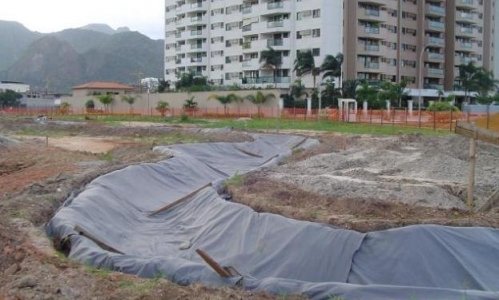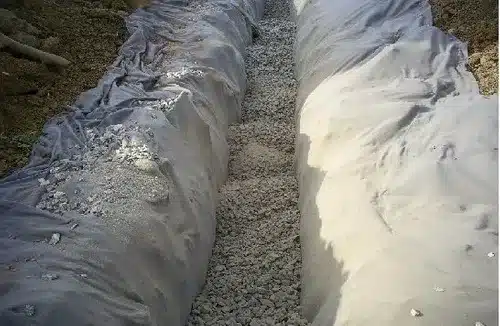

Geotextile is a type of permeable fabric that has been used for many centuries; it provides greater strength and safety for various projects.

Currently, geotextile has a wide range of applications in civil engineering, particularly for road structures, railways, tunnels, foundations, and drainage systems. Additionally, the material can be used for coastal protection or in reservoirs thanks to its protective properties.
Its benefits should be evaluated for each project according to the specific requirements, but it stands out in several ways. One of these is its high resistance to UV rays, in addition to its high-tenacity fibers. In this article, you’ll find more details on the use and applications of geotextiles—and, most importantly, how to choose the right product for each project.
What is a geotextile?
Generally speaking, geotextile is a permeable material made of polyester (PET) or polypropylene (PP). Also known as filter fabric, it is used in civil construction because it has the ability to filter, separate, drain, reinforce, or protect soil or other materials.
In addition, it comes in woven or non-woven forms. There are also knitted or reinforced geotextiles, all of which can be used in a wide variety of applications.
Geotextile has been used since the time it was known simply as "filter fabric." As for its creation, many believe that the first manufacturer of the material was R.J. Berrett in the 1950s. However, the truth is that its history goes back much further than that.
According to historical studies, geotextiles already existed and were widely used during the time of the pharaohs. They were essential in highway construction to provide greater stability to roadbeds. Furthermore, it is believed that they were the first textile fabric used by humans in history.
Today, we can say that geotextiles are everywhere in civil construction. Highways, port projects, drainage systems, and canal retaining walls: these are just a few examples that can be found in abundance.
Woven geotextile
This type of geotextile is manufactured by joining several fabrics to create a single long, uniform sheet. The result is a very strong final product that is excellent for use in the construction of roads, streets, parking lots, and highways.
Although this type is not the most suitable for separating certain materials, it offers outstanding resistance to UV rays. Thanks to these protective characteristics, the material prevents degradation in a short period of time. Additionally, it reduces long-term soil maintenance costs.
Like all geotextiles, it fulfills the six primary functions: filtering, draining, separating, reinforcing, protecting, and being waterproof. Therefore, the best type must be evaluated for each construction project based on the structure’s needs.
Nonwoven geotextile
The nonwoven type of geotextile is manufactured from long and short fibers that are bonded together by needle punching and other methods. Due to the way it is produced, this type is widely used in drainage, separation, filtration, and soil protection systems.
Despite its different manufacturing process, if made with the correct materials (without cotton), it does not decompose quickly and offers high durability. It is best suited for construction sites and projects where water volume will be high, as it has superior drainage capacity. In other words, if permeability is required, this is the ideal geotextile.
Woven monofilament
In addition to the types mentioned above, there is woven monofilament geotextile. It is usually recommended where a combination of high strength and filtration is required. It is made of individual filaments that form a mesh-like structure.
In this case, the products have aperture sizes that match the characteristics of the soil. Thanks to this, they are widely used in interlocking concrete paver systems, for example, or beneath the surface of high-flow drainage channels.
Spun-bonded
We can define spun-bonded geotextiles as those with high strength, durability, and permeability. During manufacturing, the material is spun, laminated, and heat-set, which increases its strength. Due to these characteristics, it is ideal for applications requiring a long product lifespan, such as landscaping and underground drainage.
Applications of Geotextiles
Above, you saw some of the most common uses of geotextiles. Now, by exploring the six basic functions of the material, you’ll better understand how to make the most of its potential.
Separation
In this type of application, the fabric is placed between two layers of distinct materials on two distinct soils. This can be done, for example, when constructing new soil over an existing pavement. In some cases, separation is used to provide greater stability, but there are differences in the functions.
Stabilization
In stabilization, the geotextile is applied on top of another material with a high degree of compression. The purpose of the geotextile is to drain water from the soft soil to the drainage system, creating a more reliable foundation.
Reinforcement
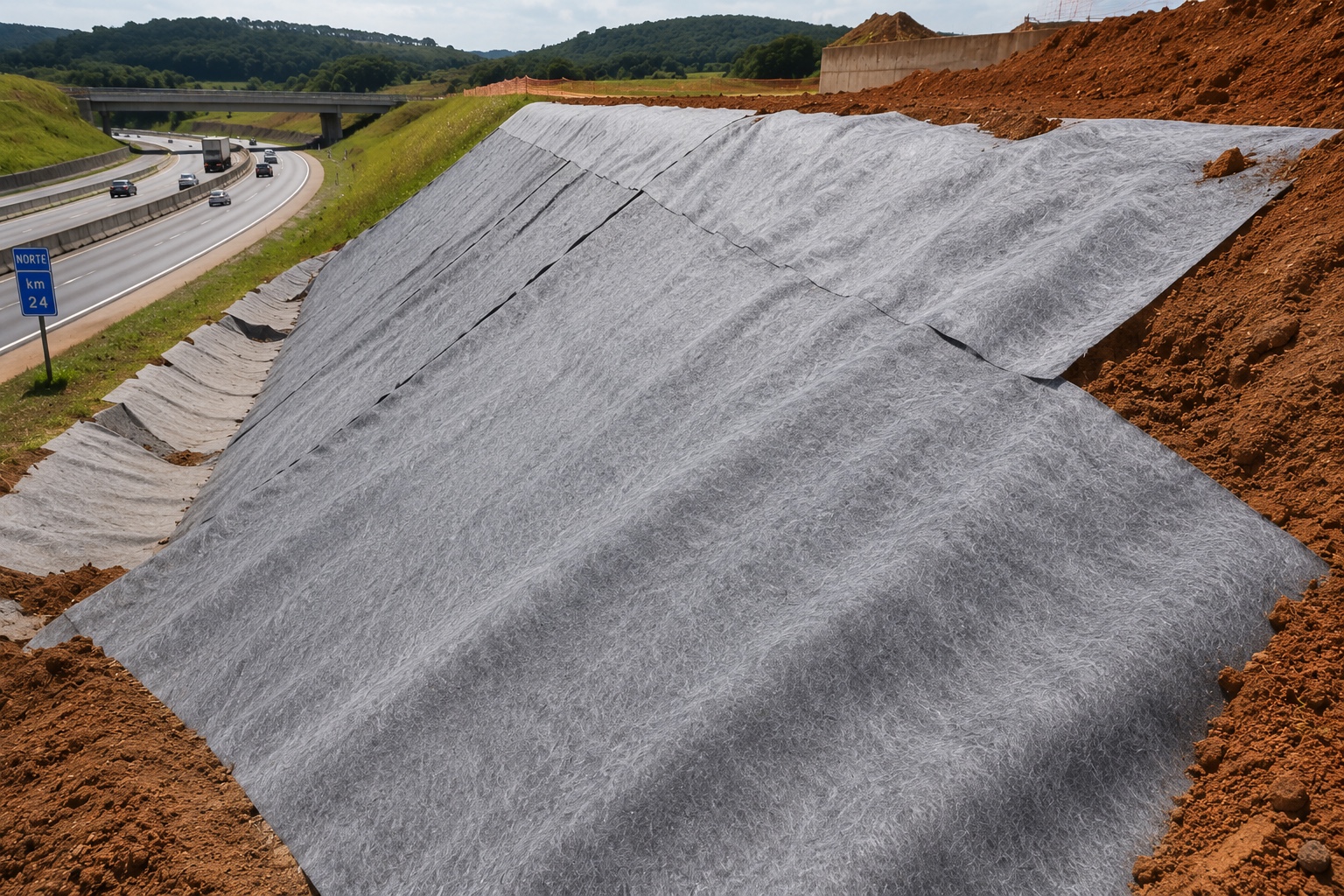
In this case, the geotextile acts as a source of strength and resistance to reinforce the underlying layer where it is placed. This application is very common on very steep slopes, where a sealing and reinforcement material is required.
Another example is retaining walls, which incorporate geotextile into their structure. Structures along canal banks and dikes also use the material to control water erosion.
Filtration
Similar to the use of geotextile in stabilization, its application as a filter is primarily to allow water to pass through the covered layer. Thus, it is possible to remove water while preventing fine particles from passing through as well. This helps maintain the integrity of the drainage system.
Moisture barrier
Unlike the applications above, the moisture barrier created by geotextile blocks water rather than allowing it to pass through. This is achieved through joint application with an asphalt suspension. In this way, the fabric becomes waterproof and can be used in projects such as pavement rehabilitation.
Drainage
In its drainage function, the material collects water (or gas) and then channels it along a path in a continuous flow. A common example of this application is in chimney or drip drains.
How to choose a good geotextile?
The first step in making your choice is to familiarize yourself with the different materials available, as you have done throughout this article. Additionally, you should pay attention to some important points, such as the experience of the company responsible for manufacturing the geotextile.
The technical properties that determine the choice
More than the type, it is the set of technical properties—all tested according to ABNT standards—that determines whether a geotextile is suitable for the project. Before finalizing the specification, evaluate:
| Property | What it indicates | Test standard |
|---|---|---|
| Tensile strength (kN/m) | The ability to withstand stress without breaking—the primary parameter for reinforcement and separation | ABNT NBR ISO 10319 / NBR 12824 |
| Apparent opening (AOS / OF) | Pore size — defines the ability to filter while retaining soil without clogging | ABNT NBR ISO 12956 |
| Permissivity / permeability | The speed at which water passes through the geotextile — essential for drainage and filtration | ABNT NBR ISO 11058 |
| Puncture resistance (CBR) | Resistance to punctures by gravel and stones — important for protection | ABNT NBR ISO 12236 |
| Weight (g/m²) | Fiber mass per m² — a reference for thickness, but not synonymous with strength | ABNT NBR ISO 9864 |
A point that often causes confusion: high weight does not, in and of itself, mean a more resistant geotextile. Two products with the same weight can have very different tensile strengths. That is why the correct specification depends on the function and load of the project—not just the “weight” of the geotextile.
Apparent aperture x soil type
For filtration applications, the apparent aperture must be compatible with the particle size of the soil to be retained. As a general reference:
- OF < 0.15 mm — fine soils (silt and clay);
- OF between 0.15 and 0.30 mm — fine to medium sand;
- OF > 0.30 mm — coarse sand and gravel.
Bidim’s RT Nomenclature
Bidim organizes its nonwoven fabric line precisely by the property that matters most in a project: tensile strength. That is why the models are identified by the abbreviation RT (RT 07, RT 08, RT 09, RT 10, RT 14, RT 16, RT 21, RT 26, and RT 31), where the number approximates the tensile strength in kN/m. In practice, the line covers approximately 7 to 31 kN/m.
These are needle-punched nonwovens made of 100% polyester continuous filaments, with low creep, good UV resistance, and chemical and biological resistance to soils found in nature. Specifying by RT—and not just by weight—is the surest way to choose the right product.
Techduto is a Brazilian company that supplies Bidim geotextiles, a brand known for the high quality of the products it manufactures. In addition to facilities in various regions of the country, which facilitates logistics, Techduto invests in technology, innovation, and cost-effectiveness for your project. Discover Bidim geotextile!