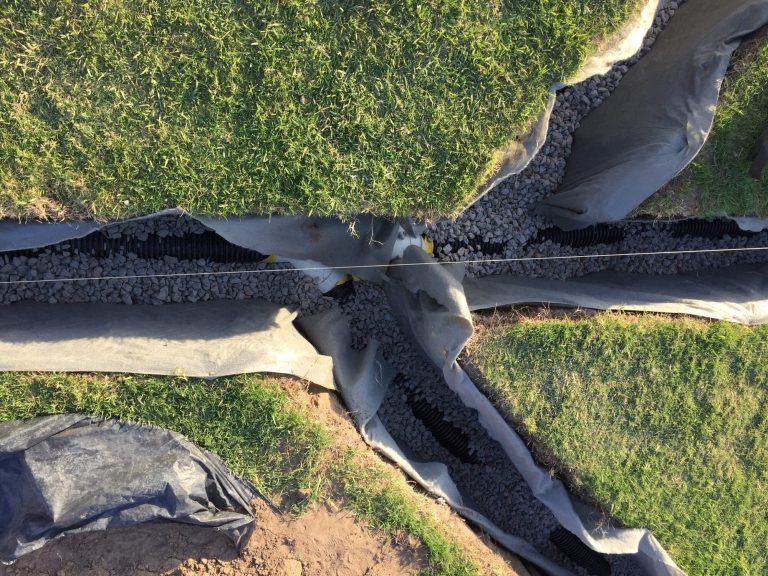


A French drain is a trench filled with granular material and wrapped in geotextile fabric, which captures water that saturates the soil and directs it to an outlet. It does not work on the surface: it addresses water that has already entered the ground and is waterlogging the base.
What is a French Drain
The name is not related to France — it comes from Henry French, the American farmer who described the technique in 1859. It is the same principle of subsurface drainage used today in highways, agriculture, and urban construction, but with materials that have evolved significantly since then.
How it Works: Why Water Enters the Drain
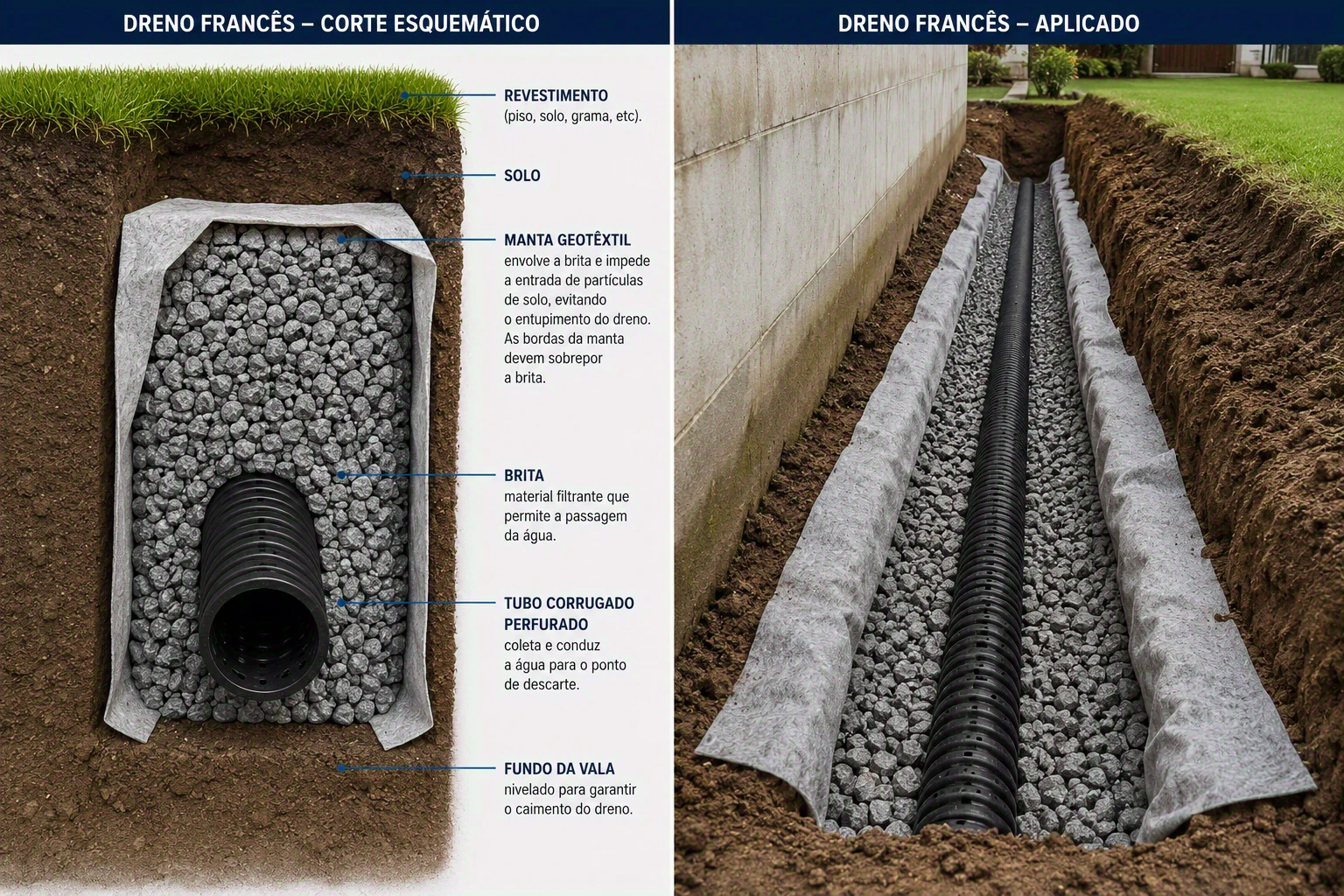
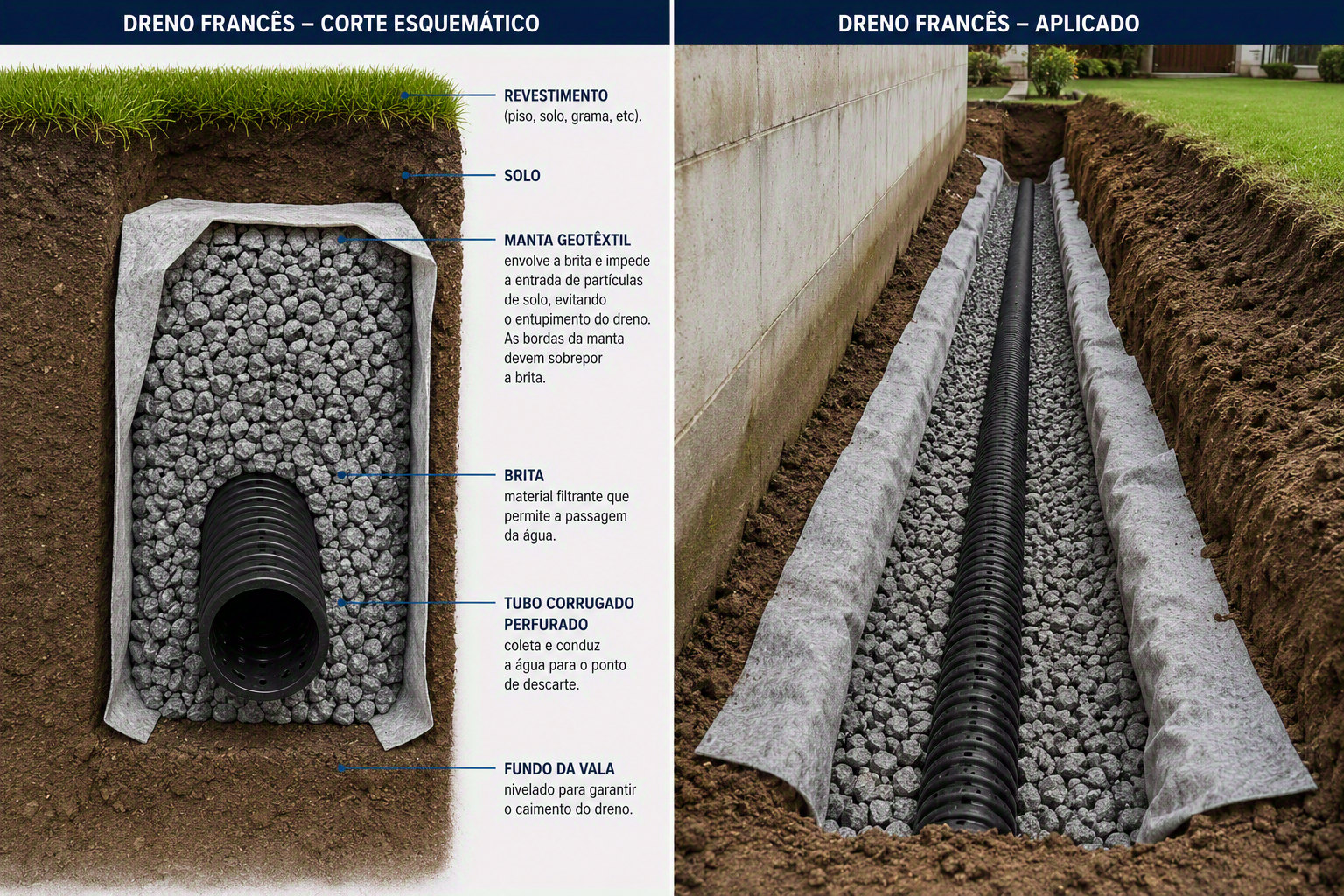 On the left, the layers in cross-section. On the right, the same composition executed on-site: the fabric lines the trench and overlaps the edges over the gravel.
Water in the soil moves from a point of higher to lower pressure. The trench filled with gravel creates a path of very high permeability — much easier for water to travel through than the compacted soil around it. It enters the drain, flows by gravity due to the slope, and exits at the project-defined destination.
What makes the system last is the geotextile fabric. It allows water to pass through while retaining fine soil particles. Without it, silt migrates into the gravel, fills the voids, and the drain loses capacity — typically between the first and third year.
French Drain with Gravel or Corrugated Pipe?
Both versions exist and serve different situations.
Gravel and fabric only works for short sections, low flow rates, and where there is good natural slope. It is simpler to install, but its conduction capacity is limited by the voids between the stones.
With perforated corrugated pipe at the bottom of the trench, water finds an open channel instead of traveling through the gravel interstices. The conduction capacity increases significantly, the possible length of the section increases, and the system can handle peak flow without backing up.
The rule of thumb: if the section exceeds a few meters, if there is a large contributing area, or if the drain needs to cover a distance to the outlet, the pipe becomes essential. In infrastructure, agricultural, or industrial projects, the version with a pipe is the norm — not the exception.
The Techdreno is the Techduto HDPE corrugated pipe for this purpose, ranging from 50 to 250 mm, manufactured according to NBR 15073. The KC line comes with the wrapping already applied, eliminating the field wrapping step.
Where a French Drain Solves Problems
- Waterlogged and slow-drying ground — subsurface water with no outlet
- Retaining wall base — relieving hydrostatic pressure that pushes the structure
- Embankment slope — reducing saturation that triggers landslides
- Sports fields and grounds — restoring usability in hours, not days, after rain
- Saturated farmland — lowering the water table in the root zone
- Foundation and basement perimeter — preventing water from reaching the structure
How to Install, Step-by-Step
- Define the water destination before digging. A drain without a defined outlet becomes an underground reservoir. The discharge point governs the entire layout.
- Excavate the trench with a continuous slope. Water flows by gravity: any reverse slope creates accumulation and sedimentation. Check the gradient with a level along the entire section, not just at the ends.
- Line the trench with geotextile fabric, leaving enough overlap on the sides to close the package on top at the end.
- Lay the perforated corrugated pipe at the bottom, with the perforations positioned according to the manufacturer’s instructions.
- Fill with clean, graded gravel. Dirty material or material with fines compromises the system from day one.
- Close the geotextile envelope over the gravel, overlapping the flaps.
- Cover and identify the layout in the as-built drawings, so future maintenance does not damage the drain.
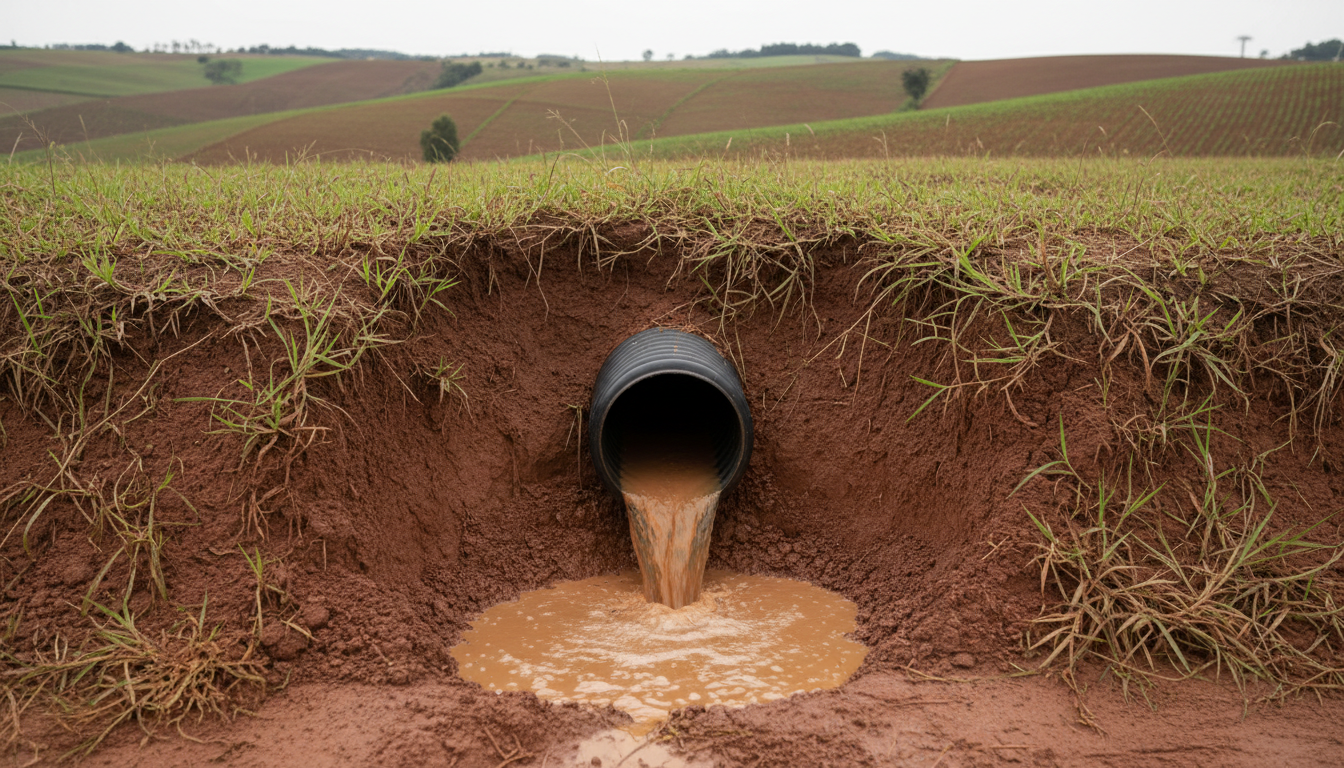 Well-resolved outlet: the discharge point defines the entire drain layout.
Slope, Depth, and Width: What Defines Each Number
There is no universal measurement — the numbers come from the project design, and this is what separates a functional drain from one that clogs.
- Slope must be continuous and sufficient to maintain flow velocity. Insufficient slope deposits sediment; excessive slope in erodible soil brings another set of problems.
- Depth is a function of where the water to be captured is located. Draining the base of a pavement is different from lowering the water table in an agricultural area.
- Width and diameter are determined by the contributing flow rate. Undersizing the pipe is the error that only appears during the first heavy rain.
For a quick estimate of flow rate and diameter before detailed design, the drainage calculator performs the calculation using the Manning formula directly in the browser.
Mistakes That Clog a French Drain
- Installation without geotextile fabric — the most common and most expensive mistake. The drain works for the first year and then fails silently.
- Gravel with fines — reduces void index and accelerates clogging.
- Reverse slope in any section — creates pockets of standing water and sedimentation points.
- Poorly resolved outlet — a drain discharging into a flooded area does not drain anything.
- Undersized pipe — works for average rain and backs up during design storms.
- Compacting from above without protection — damages the pipe and tears the fabric even before construction is complete.
Cost
The cost per meter is governed by excavation, gravel volume, fabric type, and pipe diameter — in that order, in most cases. The item that usually weighs the most is the transportation and placement of gravel, not the pipe.
It is worth comparing with the cost of not draining: construction delays due to impractical ground conditions, slope repairs, foundation pathologies, and lost harvests in waterlogged areas.
Frequently Asked Questions
Gravel-filled trench drain with fabric (the classic French drain), drain with perforated corrugated pipe inside the trench — used when there is significant flow or a long section — and drain with geocomposite, which replaces gravel with a drainage core already wrapped in geotextile, used where space or access to granular material is restricted.
Generally: surface drainage (conveys water running over the ground), subsurface or deep drainage (captures water already in the soil, like the French drain), base or pavement drainage (protects the road structure), and agricultural drainage (lowers the water table in the root zone).
It is the version without a pipe: the trench is lined with geotextile fabric and filled with gravel, and the gravel itself conducts water through the voids between the stones. It works for short sections and low flow rates; when the distance or contribution increases, the void capacity is insufficient, and a corrugated pipe must be included.
Subsurface drainage. It intercepts and conveys water saturating the soil profile out of the area, lowering the water table in the area of interest. The French drain is the most widespread form of this technique.
Yes, it does. Without the fabric, fine soil particles migrate into the gravel and clog the system. It is the difference between a drain that works for decades and one that loses efficiency in a few years.
Some References
- ABNT NBR 15073 — Corrugated polyethylene pipes for drainage
- French, H. F. Farm Drainage (1859) — original description of the technique